Articles Precision (Page 17)

By Colin Jordaan

NATAL PILOTS MAKE IT 1-2-3

Natal pilots have shown that they mean to be at the forefront in the race for Springbok Colours next year by pulling off most of the line honours in this year’s Nationals. Twenty-seven of the top Precision pilots in the country met at Krugersdorp Airfield late month to do battle for the highest honour in the sport – National Precision Flying Champion. Seeded through from last year were: Springbok Dave Perelson (reigning Champion), Andre Schoeman and Johan Swart. The remainder represented their various provinces after competing in Provincial Championships.

The latest FAI Championship Rules were used for the competition. Day 1 consisted of a Flight Planning Test, Navigation Test and an Observation Test. Day 2 was a repeat of Day 1 but over a shorter route. This was followed by a series of spot landing competitions which included flapless forced landings and approaches over a 2 m high barrier, places 50 m before the touch-down line.

The rules require that only single engine aircraft are used being flown solo by each competitor. Penalties are awarded for failing to meet certain requirements in each task and the pilot with the least number of penalties at the end of the last day is the winner.

The World Precision Champs are being held in Finland this year and for obvious reasons, South Africa will not be there. However, we have been invited to compete in the European Championships next year and a Springbok team will be chosen on performances in this and next year’s Nationals. Having flown in three World Championships, I have formed the opinion that not only do we suffer from lack of International Competition, but our training and preparation has been a bit off course (no pun intended).

With this in mind, I set the two navigation courses with the purpose of applying various types of pressure on the competitors. Obscure turning points were chosen, the pilots only being able to spot the marker about 30 to 40 seconds before crossing. This only if they were no more than 250 metres off track. Secret checkpoints were placed in cuttings and behind trees to ensure that these would only be observed if competitors were dead on track. Timing had to be to the second at all times and no circling was allowed in order to waste time.

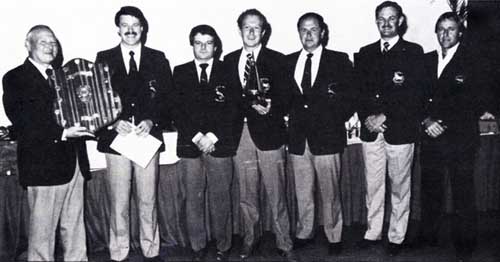
Natal 1987 Precision Team
L to R: Charles Wotherspoon, Colin Jordaan, Adrian Pilling, John Campbell, Dave Campbell, Richard O’Neill and Barry de Groot (Reserve)

Day 1 saw the pilots negotiating a route around and over the Magaliesberg, heading back to the south of Randfontein and finishing up between Lanseria and Krugersdorp for a total of 104 nautical miles. Pilots also had to identify 5 air to ground photos and 12 ground markers on this route. Tensions were running high as the provisional results were issued that night. The corrected results put Springbok Adrian Pilling into the lead, followed by Dave Perelson, Dane Gerneke (WP), Peter Lastrucci (S. Tvl), Dave Campbell (Natal) and in sixth place, Ivanhoe Perelson, reigning Rally Champion and the only woman in the competition.

Only 1 point behind Ivanhoe was Gerrit van Wyngaardt from S. Tvl. The Rookie of the year award must surely go to 19 year old Gerrit for this performance with only 90 hours, flying in his second competition. I hope this will serve as an inspiration to all of you who have been too chicken to have a go at competition flying.

On day 2, aircraft were sent out on a 74 nm. course (curse?) consisting of 8 legs. The observation task consisted of 6 photos and 9 ground markers. The competition is meant to be flown over various types of terrain. On the West Rand 1:250 000 map this means having to navigate on large yellow blobs while overflying built-up areas. I used 1:50 000 maps while setting these stages and I take my hat off to those pilots who were able to stay on track using the competition map.

Adrian Pilling 1st Place 1987
Charles Wotherspoon handing over the Frikkie Moolman Memorial Trophy to Adrian Pilling

Spot landings on runway 08 proved a bit much for some of the jockies. If you have landed at Krugersdorp before you will know what I mean. Pets Lastrucci used his local knowledge to fullest extent by winning with only 34 penalties on 4 landings. Seeing that every 1 metre short on a glide approach incurred 6 penalties, this was a magnificent achievement. Dave Campbell, Adrian Pilling and Dave Mostert took the next 3 places.

The prize giving dinner was held at the Krugersdorp Game Reserve where nearly all the pilots were staying. The Nationals were part of the Krugersdorp Centenary Celebrations and Mayor Gert Visser and his lovely wife were our guests of honour. The provisional results were once again handed out and after all protests were considered, the computer churned out the glad tidings for some, bad news for others.

Mr Charles Wotherspoon, former Chairman of Power Flying, presented the prizes to the deserving winners. Springbok Adrian Pilling had managed to hold on to his lead to take the crown and become the 1987 S.A. National Precision Flying Champion. All competitors were very glad to hear that Erika Moolman has agreed to reintroduce the Frikkie Moolman Memorial Trophy for First place. Natalians, Dave and John Campbell took 2nd and 3rd places respectively. Having recently won the Natal Air Rally as a team, these achievements must have been extremely satisfying.

In 4th place overall, and winner of the Private Pilot’s Trophy was Springbok Rally pilot, Chris Kyle from S. Tvl. Chris also has the distinction of being the winning navigator in this year’s State President’s Trophy Air Race.

Dave Perelson had to be content with only a fifth place this year and will be a real force to be reckoned with next year at the coast. After a very good second day, Geoff Hanschel from the OFS managed to take 6th overall and 2nd in the Private Pilot Section.

The Team Event was very obviously won by Natal with S. Tvl, E. Province and W. Province following.

S A National Precision Flying Champs

Held at Margate on 10-11 May 1985

By Renier Moolman

Pretty-Boy Bass, Sideways Seymour, Able Adrian, Good Better Beck, Joystick Jordaan, Killer Kyle. No! This is not a list of whatchamacallits. These are some of the most accurate and skillful pilots in this country. Twenty seven competitors representing six provinces and no less than five Springboks took part in the 1985 South African Precision Flying Championships held at Margate. Natal had two Springboks in their team, Mike Basson and Gavin Beck, whilst Western Province had Mike Seymour and Northern Transvaal boasted two Springboks, Chris Kyle and Colin Jordaan (who has already been capped three times).

Well, you might ask how did I know about all this? A nice guy by the name of Dennis “Pitts Special” Spence kindly invited me along for the ride.

So, jors troelie fox-trotted down to Margate in Dennis’ Warrior. Dennis is an SAA Airbus pilot but showed that he is equally at ease behind the stick of a little “gogga” when, in the Northern Transvaal/Southern Transvaal Provincial’s Landing Competition, he finished 20 percent ahead of the second pilot.

This year, the Precision Flying Champs were based on the World ones. It consisted of two navigation exercises, one on the Friday morning and the other on the Saturday morning. These exercises made up for 70 percent of the total score, with the remaining 30 percent consisting of a landing contest.

Friday morning at 06h00, I was out fishing and by 8h00 having had no joy, I made my way to Uvongo Beach. I had hardly settled down with my binoculars to do a bit of bikini watching when a giant vulture filled my lenses. It was heading down the river at zero level, and right overhead it did a wing-over and headed off towards the airfield.

Beck, Mostert, Hartley, Gililand, Basson, Wotherspoon, Pilling
L-R: Gavin Beck, David Mostert, Mike Hartley, Maj Gen James Gililand, Mike Basson, Charles Wotherspoon, Adrian Pilling

I then realised that I was sitting on the final turning point before the guys did a final overhead time check at the airfield’s windsock.

Dennis Spence, in his Warrior, Kilo Fox Fox, was the first competitor to pass overhead – then at regular intervals. It was interesting to watch the different ways the pilots handled their aircraft over the turning point. Some did acrobatics, some flew very casually and Steve Hartley and friend screamed into the check point “flying united”. His Bonanza looked like a biplane.

Another well loved friend of flying, John Adams, decided that this turn point was where he was going to end his navigational exercise, and zoomed off for a sightseeing flight down the coast. Eventually, he joined a normal left downwind and rolled to the parking area. When he strolled into the hangar, the chief judge asked casually. “John, what time were you overhead the windsock? We seemed to have missed you.” To which he replied: “Er, huh, hrnm….. well, I taxied past the windsock at about, er, hm……. ” It is great to see that apart from the serious flying, there is also humour in the competition. Thanks to the guys who blew this checkpoint and could still laugh at themselves afterwards.

Well, back to the serious business and how the precision navigation exercise worked.

The organisers had laid out a route which started off at Margate. It had several legs which had to be followed (one was a curved leg) and finally after about four or five turning points, ended at Margate again.

Each aircraft had nominated a groundspeed and thus the pilot, after takeoff, had to be at a checkpoint at a certain time, failing which he would be penalised for arriving overhead too early or too late. I must mention that some pilots still haven’t arrived at some check points.

One of the main factors that the pilots had to take into account was the wind direction and speed. These two factors can cause a great deal of worry if they don’t compensate and get blown off track and/or arrive at a checkpoint too soon or too late.

Each checkpoint was manned by observers – some were marked on the pilots’ maps and others were secret checkpoints en route. Their duty was to log each competitors’ time and position overhead at that checkpoint. For every so many metres, the aircraft was off track either side of the checkpoint, the judges would allocate penalty points accordingly. If a competitor flew outside the prescribed corridor, he would receive maximum penalties for that checkpoint. Great accuracy is demanded from competitors as each second that he is out on his ETA costs him one point.

Apart from having to put up with all of this, the competitors have secret checkpoints along the routes. These are in the form of a symbol in canvas or plastic placed on the ground. When a competitor observes one of these, he has to plot its exact position on the map. Before taking off, he is also handed a set of six photographs. He has to study these carefully. En route, when he recognises any of these photographs on the ground, again he has to plot the exact position on the given map.

For each observation error (check-point missed) a further 50 points are lost.

Saturday afternoon, Margate was like a little baby – wet and very windy. The wind was blowing head on runway 22 at knots-plus-plenty and left a few guys redfaced. Believe you me, I stood next to the runway trying to judge the landings, but my body was also tuned to the check or race mode – check the position if they landed or race for my life when some pilots, like Sideways Seymour, approached.

Each pilot had four landings to execute, so they were sent off in batches of four, spacing themselves as necessary.

The first landing was a normal approach with power and flap. The second was a glide approach, with flap and sideslip permitted. The third landing was a glide approach with no flap allowed. It was especially during this approach that some pilots under-estimated the wind velocity and undershot so badly that they would not have made the runway had it not been for taking power and starting up the fan up front to cool them down.

The final obstacle to fame or flush was the power landing but this time with a two metre barrier across the runway. A pilot was not permitted to sink below the barrier before he actually crossed it.

On the runway, inside the set corridor, was a white one metre wide zero touchdown line. This was the point the pilots had to aim for. For every metre a pilot overshot, he was penalised by one point, up to a maximum of 50 metres. The same applied for undershooting, except this time penalties were doubled.

The “landing point” was only scored once both main wheels were firm and running on the ground.

Renier Moolman, Mike Basson and Charles Wotherspoon
Mike Basson (left) receiving his trophy from Renier Moolman. Charles Wotherspoon in the background.

The Frikkie Moolman Memorial Trophy to the first pilot overall went to Mike Basson. On the final day of the Nationals, Mike’s father died after being ill for some time. As Mike said afterwards: “This one I flew for Dad” and believe me, he did. Mike is from the South Coast, where he learnt to fly in 1969 at the old airfield (now the golf course). If you are lucky enough to tune into Radio Port Natal everyday, Mike is your wellknown local “eye in the sky”, giving you traffic updates. During the 1981 World Precision Flying Championships, Mike represented South Africa and came 16th overall.

Mike Seymour was second. Mike runs the Good Hope Flying Club and also does a lot of Red Cross Mercy Flights. Mike has shown consistency as he was the overall winner last year. Mike was the manager of the Springbok team which competed in the World Navigational Rally Championships at Parma, Italy last year.

In third place overall, and the first private pilot was Adrian Pilling from Natal who won the Peter Wotherspoon Memorial Trophy. I tried to speak to Adrian about his flying experience but he was so up the in clouds that there was no way that I could get down to earth for a chat. The only bit of information I could get on trying to find out where he was from or what he does was a voice somewhere in the crowd which commented, “Apprentice Millionaire.”

Dave Perelson, CFI of Algoa Flying Club in Port Elizabeth was fourth.

Fifth was the S.A. Navigation Rally Champion and Springbok from Natal, Gavin Beck. Gavin, together with his pilot, Chris Kyle from Krugersdorp are the current National Navigation Rally Champions. Gavin, Chris, Frikkie Moolman and Peter Wotherspoon were the pilots in the Springbok team last year. After Frik and Pete’s tragic accident, Gavin and Chris decided to continue in the Championships. On the first day they were placed fourth overall. In the final result they were among the top pilots and both were called up to receive President of Italy’s Medal at the prize-giving for their great sportsmanship.

Usually the top five pilots selected for the Springbok team. This year due to the bad economy, finances alone will determine whether a full team will compete at the World Champs at Kissimmee in Florida, USA. Politics have marred sporting events and this might be the last time for a couple years that we will be able to send a team overseas. So all you guys with fat wallets or tax problems, it is time you did something for Sport Aviation.

But standing on the sideline, one thing became very clear on the weekend …… a little bit of the magic has gone. Can’t help but miss them, ol’ Frikkie Feathers and Propeller Pete …… don’t you?