
WORLD FLYING CHAMPIONSHIPS – 2006

Incorporating the 15th World Rally Flying Championships,
and the 17th World Precision Flying Championships

Troyes, France – 21 to 31 July 2006.

By Chris Booysen

S A Rally and Precision Team Logo

Part 2 – The Precision Flying Championship

Saturday, 22 July

After the last practice day the team attended the Official Opening last night. Once again it was very hot with a small thunderstorm forcing the opening ceremony inside.

The function was held in the Town Hall and was followed by a dinner hosted by the mayor. One of the guests was a cartoonist and drew pictures of the team. If I can find a scanner I will post them. The team gave a rendering of Shosholoza to express our thanks.
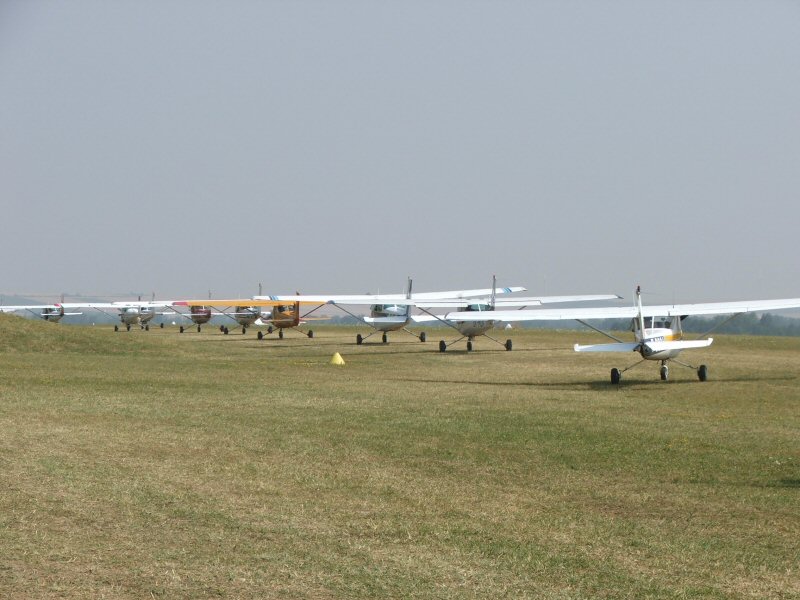
The queue of aircraft – waiting for their landing.

The landing test comprises four landings. A normal landing, two forced landings (one flapless) and a landing over a barrier. Past competitions have shown that to win in this section of the competition you need to land all four landings within a meter of the “bingo” line (The bingo line is 2 meters wide).

The landing competition was divided into two sessions. A morning session where each pilot performed landing 1 (normal landing). After the full field of 62 pilots had completed the first landing then the second landing (forced landing) was completed and then there was then a break for lunch. At lunch time the field was led by Krzysztof Wieczorek from Poland with two penalty points. As usual the top positions were held by Poles, Czechs and the Swedish. Mary de Klerk and Ron Stirk were in the top ten for South Africa with 9 and 12 points respectively. Hans Schwebel, Jan Hanekom, Barry de Groot and Frank Eckard are also in the top quarter of the results.

After lunch the second two landings were performed. The team was disappointed by the first four landings of our team as they were all short of the box incurring penalties of 150 each which put them out of the running. Things immediately picked as Ron and Mary did two fantastic landings which put Ron into a tie for second place with a total of 14 points. Mary was also well up the field in tied 4th place with 24 points. First in the landings was Kryzysztof Wieczorek with 10 points. In all the South African team members get six bingo landings.
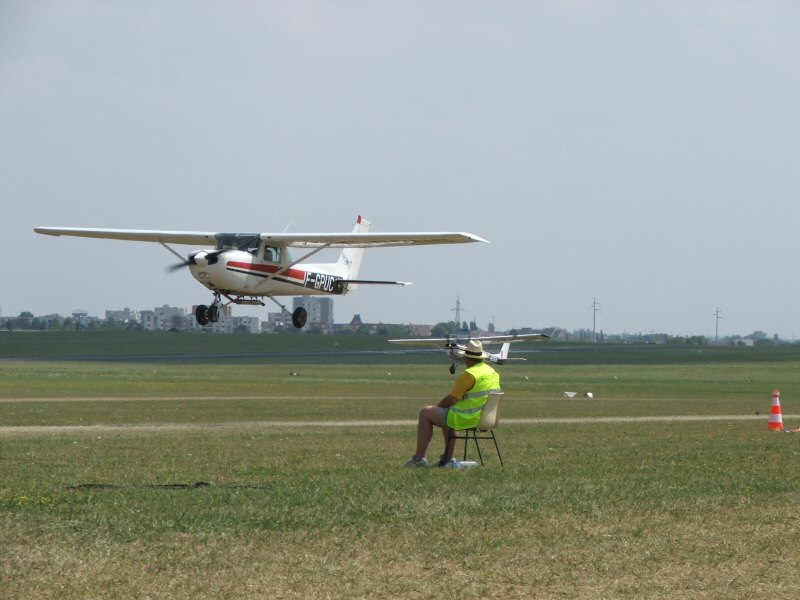
Ron Stirk – heading for a Bingo.

At the evening briefing a petition was presented requesting that the first two landings be cancelled as the teams who signed it believed that the tail wind component during the landings exceeded the maximum allowed of 3 knots. South Africa did not support the protest as we believe that the wind was the same for all competitors so there was still a fair competition. This petition was rejected as the rules only allow for individual protests. Four competitors from different countries then lodged their protests.

The jury viewed the official recordings of the wind during the landings and found that there had been a tail wind component in excess of 3 knots in the case of a few landings and was therefore forced to cancel the two landings performed in session one. The jury left it to the discretion of the competition director to decide if the landings would be flown again. The competition director decided that no further landings would be held and that the results would be based on the second two landings only. South Africa supported this decision as the rules do not allow the re-flying a portion of an event.
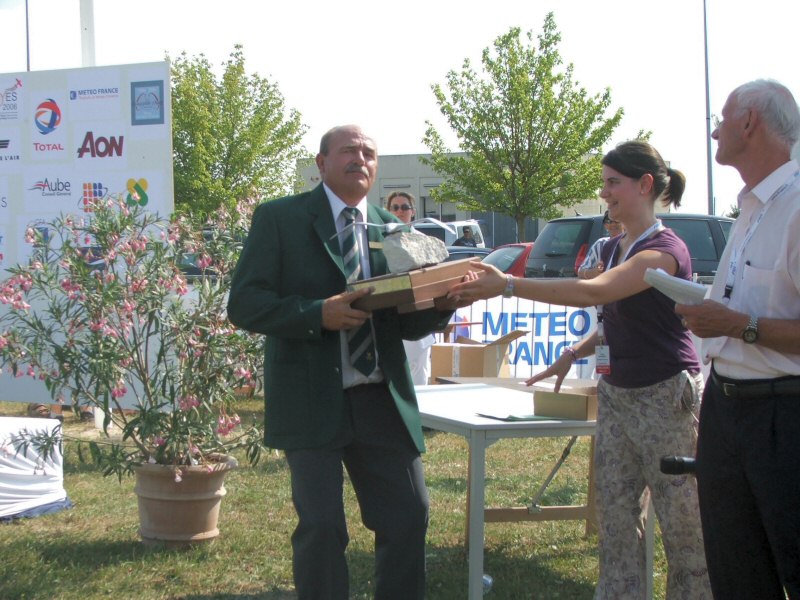
Ron Stirk – World Landing Champion.

The result of the rulings was that Ron Stirk was moved up to first place in the landings on 2 points. A fantastic result for South Africa. This is the second time that Ron has been World Landing Champion. With good landings by Mary and Frank in the second session South Africa will be third in the team landing results.

The ruling on the landings has had a mixed effect on the competitors depending on their results in the first and second landing sessions. In terms of the rules the points of the two landings not cancelled are doubled. A number of our team members had two very good landings in the first (cancelled) session and not such good landings in the second session. This means that they carry the double the penalties for the bad landings though to the final result.

The two navigation exercises were difficult. Penalties for all competitors are significantly higher than the penalties incurred at the last World Championships in 2004. Both navigations included 10 ground markers and 6 ground targets, as well as ground targets at the turning points. Very few turning points were timed (only 3 per route). There were a large number of secret timing points. Secret timing points can be placed anywhere on the route and are not marked in any way. This forces competitors to fly at exactly their nominated ground speed.

Our results for the first navigation are satisfactory but are not good enough for us to be in medal contention. Mary de Klerk has performed well and is the lowest scoring team member in 26th place. She is followed by Hands Schwebel and Frank Eckard. Unfortunately Jan Hanekom missed a turning point that required a one minute timed turn which meant that he was penalised for missing the turn and for two track errors. This alone costs 600 points. Ernie has also missed some turning points and secrets.

The second day is almost a repeat of the first in format and results except this time Jan Hanekom hits all the turning points and improves his score dramatically. Mary was once again the first South African in 27th place followed by Frank Eckard (31st) and Jan Hanekom (32nd)
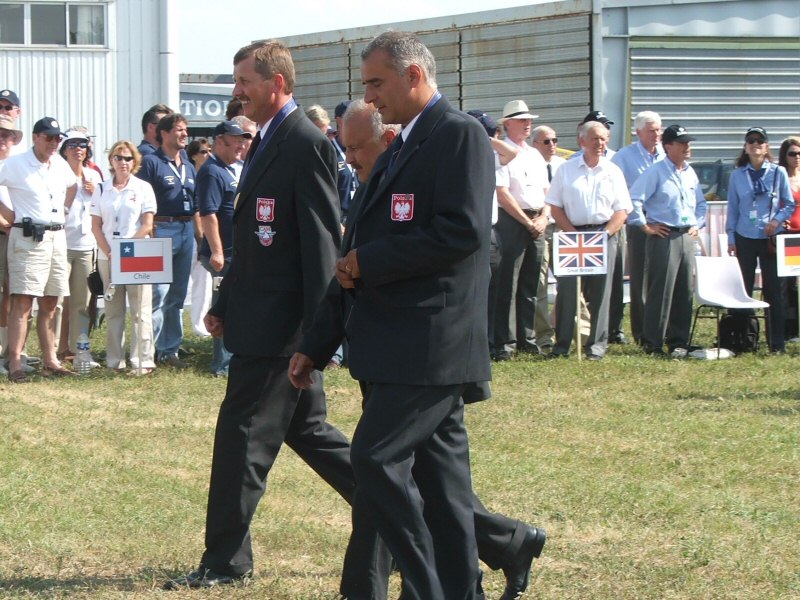
The Medalists – Poland.

Due to the good weather we do not need the reserve day so the team members took the day off and got a well deserved rest. The only item on the program is the final prizegiving function which was held at 4:00pm outside the terminal building. The temperature is 37 degrees with a cloudless sky. Not really the weather to be dressed in our formal Protea clothing!

The Polish team take almost all the trophies and awards. They take all the individual medals with Krzysztof Wieczorek (Gold), Janusz Darocha (Silver) and Krzysztof Skretowicz(Bronze) in the top three places. They are also awarded the Ottley Trophy a the Team Champions. In the team competition the Czech Republic team are second followed by France and South Africa. From a South African perspective our top three individuals are Mary de Klerk, Frank Eckard and Ron Stirk.

In the landing competition Ron Stirk is awarded the Canada Trophy and is the World Landing Champion. The Polish receive the New Zealand Trophy as the top team in the landings.

As a country we had set ourselves some objectives which included a landing medal, a podium position in the overall results, a top 3 in the team landing position and possibly an overall medal. We have achieved the landing medal, top 3 in the team landing and 4th in the overall team results. The team can be very satisfied with its performance.

Full results and pictures can be found at the Official Troyes Website


WORLD FLYING CHAMPIONSHIPS – 2006

Incorporating the 15th World Rally Flying Championships,
and the 17th World Precision Flying Championships

Troyes, France – 21 to 31 July 2006.

By Chris Booysen

S A Rally and Precision Team Logo

Part 3 – The Rally Flying Championship

Thursday, 27 July

The official program for the Rally Flying Championship is an official practice day on 27 July 2006, followed by three competition rallies and then a reserve day and the prize giving on the 31st July.

The competition director has spaced the field in such a way that aircraft would be flying from 9:30 in the morning up to 17:00 in the afternoon. This, combined with a forecast of severe thunderstorms, leads to the officials postponing the official practice day. All teams are handed the route for the day and all fly the route as a practice with no weather related problems. The forecast thunderstorms never appear so the event could have been run as planned.

The forecast for the second day is also for severe thunderstorms. After the incorrect forecast of the previous day it was decided that the official practice day would be run but with the field far more compressed so that the flying will completed earlier in the day. The official practice day is run as if it is a competition except the scores are not taken into account

Once again the forecast is incorrect and the weather is good, overcast and much cooler. The practice was a good one for the South African team as it allows us to sort out the last few problems. The team is now ready for the competition.

The first competition day dawned. The teams are given their instruction 25 minutes before take off. Added to this are another 5 or so minutes flying to the start which means most can plot the entire route before the start line. The route contains an away landing, an arc that needs to be flown and some turning points that are in a sealed envelope. The first competition day is a bit of a disaster. Each of the our teams made a silly mistake which results in penalties. All the SA team members are lying between 30th and 44th place. The local French team is doing well as are the Poles (of course). As a country we are lying in 9th place, far below our expectations.

As a result of a protest by Poland a number of legs are cancelled. The instructions in the sealed envelope follow after three turning points from the turning point that indicates which envelope must be opened. The rules require four points.

The route for the second day of the competition was similar to the first day. A long time to plot, an arc to fly and an away landing.

The South African team had an even worse day than day one. Most of the team do not see that they were not allowed to fly over a small village that was situated on the flight path immediately after the touch and go away landing. This resulted in 200 penalties. Added to that were a few missed check points, a some incorrect plots, a bad landing or two and a number of missed photos. Frank Eckard fare the best of our team with 658 points. They are followed by Barry de Groot and Mary de Klerk who flew incredibly accurately (46 flight penalty points) but ended on 686 points due to the landings, en-route photos and the penalty for overflying the village.

The top South African team is only in 32nd place. A huge disappointment for the team. The dissapointment is tempered slightly when the team manager, Chris Booysen, is called up at the prize giving to accept the Credit Agricole Trophy for “Team Spirit and Fair Play”.

Full results and pictures can be found at the Official Troyes Website


Pictures taken by various team members
Ernie and Francois
New SA Team Ernie and Francois
Emily, Chris and Frank
Emily of the Info Desk
Anita, Lorraine and Barry
After a hard day
Typical scenery
Typical scenery of the area
Typical scenery
Typical scenery of the area
Typical scenery
Typical scenery of the area


2006 Bank President’s Trophy Air Race

Held at Klerksdorp – 25 to 27 May 2006

Competition Director Kassie Kasselman at the Thursday evening briefing
“The Most Prestigious Aviation Event in South Africa” and “The Largest Air Race in the World”. These are some of the words used to describe the President’s Trophy Air Race. The 2006 Race did not disappoint.

This year showed a record entry of 110 aircraft, the largest ever. In fact this number will probably not be exceeded without a change to the format of the race as there is a limit of the number of aircraft that can safely land on an airfield over the short period of time as is required on day 2 of the Race.

Organised by Kassie Kasselman and the Klerksdorp Pilots Association (KPA) and well supported by sponsors Marsh, Alexander Forbes, Air BP and Naturelink the 2006 race was one to remember. Apart from a small hitch with the supply of fuel due to the bowser breaking down on route to the airfield, the organisation was slick and went off without any major snags.

On arrival it was obvious that a lot of effort had gone into the planning of the event. The airfield was immaculate with numbered parking for each aircraft. This new innovation was given the thumbs up by all participants except a few with race numbers above 90. These guys were parked very far from the action. There were also two large marquee tents, a red and white striped one for general socialising and a separate white one which was used to house the registration area and for the pilot briefings. It is indeed a pleasure for the pilots to be able to listen to briefings without having the distraction of the noise of supporters and spectators enjoying themselves.

The Fuel Queue
The Fuel Queue
The format for the 2006 was unchanged and the program comprised of an arrival day and two race days. This year the arrivals were compacted as there was fog over most of the Gauteng area resulting in late departures for Klerksdorp combined with a sterling effort of all pilots attempting to arrive before the cut-off at 12:00.

Those that missed this arrival action were the winners of the 2005 Air Race, Andre Koen and Errol janse van Rensburg. They arrived a few days early to get in some practice. They were determined to defend of their title. This feat has previously only been achieved by two pilots, Mike van Ginkel (1969 and 1972) and Robbie Schwartz (1984 and 1988).The first briefing was held on Thursday evening in the white tent. On this occasion Chris Booysen handed out 10 Year Badges to Walter Walle and Johnny Mayer (Snr) and also congratulated Jannie Visser on his 21st Air Race. The safety briefing was done by Graeme Conlyn. An improvement that organisers should consider for the future is to give the participants a written briefing to take away with them. This would result in a shorter briefing giving the crews more time to prepare their maps.

Johnny Mayer accepts is 10 Year Badge from SAPFA Chairman Chris Booysen
The route for Day 1 was from Klerksdorp to Schweizer-Reneke, Zeerust, Fochville and back to Klerksdorp a distance of 319 nautical miles. While the navigation was not too difficult flying conditions were with a quartering North-Westerly wind all around the course.
As is normal the fastest aircraft left first and the slowest last resulting in the field spreading along the route. The take off’s were every 30 seconds with the TV chopper buzzing up and down the side of the runway to ensure adequate footage for the TV broadcast on Supersport, as well as for a DVD that would be sold to competitors.

Race 26 Booysen and Tucker: Inaccurate flying after Schweizer and doubling back to pass Zeerust cost Race 26 at least 7 minutes
Inaccurate flying after Schweizer and doubling back to pass Zeerust cost Race 26 at least 7 minutes
The day was not without incident as Race 103, the Samba of Hubi von Moltke and Gerald Ackhurst started overheating so they decided to a precautionary landing. Race 108, the Turbo Arrow of Mike Mayers and Werner Swart did a forced landing with a problem with a fuel indicator pipe. There were other tales of woe after day one. In total there were 7 aircraft excluded from the results for various reasons.
Inaccurate flying after Schweizer and doubling back to pass Zeerust cost Race 26 at least 7 minutes

Race 15 finds Schweize-Reneke - eventually
Race 15 finds Schweize-Reneke – eventually
One of the hard luck stories was that of the experienced Myburgh father and son team in Race 15. They were marked as not observed at Schweizer-Reneke but their logger track shows clearly that they passed overhead, albeit after an extended cross country that would have meant that they had little chance of ending anywhere in the top half of the results. (Ed – maybe the marshals had gone home)
The largest time gain for Day 1 was achieved by John Sayers and Cilliers Manser in the Harvard. They were closely followed by the Albatross of the Marx brothers and the Arrow IV of Dana and Daniel Bensch. What is interesting is that all these competitors were on the waiting list and only got into the race as a result of withdrawals of other competitors.
While a full analysis of the logger tracks has not yet been done it appears as if the shortest distance on Day 1 was flown by Race 69, the Jabiru of Sias Truter and Louis Terblanche.
A strict application of the rules saw a number of time penalties being handed out by the competition management which were ratified by the jury. One crew was excluded due to dangerous flying. This is a good sign as competitors need to know that unsafe flying and breaches of rules will be severely dealt with. This also changes a trend that crept in over the past couple of years.

Official opening Kassie Kasselman (Race Director), Cliff Lotter (Chairman KPA) and Executive Mayor China Dodovu
The route for day two was a bow tie course to Kroonstad, then to Parys, back over Klerksdorp on the way to Lindberg Lodge, Lichtenberg and home to Klerksdorp. The distance was 327 nautical miles making the total distance for both days of the event just over 651 nautical miles.
It is always difficult to explain to a newcomer how the start times of day two are determined. The best way to explain it is that the competition director decides on a finishing time for the end of Day 2. The scorers then calculate the start time of each aircraft using their handicap speed that will result in the aircraft finishing at the designated time. As it is a two day race the calculated is adjusted by the time gained or lost on day one so that aircraft that lost time on day one will start later than their designated time and aircraft that gained time will start earlier than their designated start time.
Day 2 was not without its share of drama. Johan la Grange and his daughter did a precautionary landing in their Jabiru as the fuel warning light was on. This turned out to be a false alarm but the aircraft tyre was punctured which put an end to their race. Race 97 also withdrew after aborting their take off.
The main news for the day was the forced landing of potential winner Race 110, the Harvard of John Sayers and Cilliers Manser due to a fuel problem. This happened on the last leg of the race.

President's Trophy Air Race - WSE Harvard: The logger track of the Harvard tells a story
The logger track of the Harvard tells a story
Oblivious to all this drama were the members of the Association of Virtual Aviators (AVA) who were flying the equivalent air race in a hanger on the airfield. AVA and SAPFA have developed close links with AVA competing alongside SAPFA members at the Air Race and at Rally Flying Championships. AVA members have also developed scenery to help the Protea Flying team get some virtual practice in France prior to the World championships later this month.
Logger tracks show that the Day 2 route was a more difficult navigation exercise especially the leg between Lindberg Lodge and Lichtenberg. Almost all the aircraft strayed to the left of the direct routing from the Lodge to Lichtenberg. The turning point was fairly easy to find so most aircraft made the correction close to Lichtenberg and passed over the turning point and the marshals. Most entrants thought the Lodge would be difficult to find but this was not the case. The leg from the Lodge was also difficult as the wind direction swung 180 degrees during the leg.

The finish was spectacular with 94 aircraft finishing within 40 minutes. The circuit was large and spread out over the Vaal River, approximately 7 miles away. A challenging cross wind made some of the landings a little more spectacular than the pilots would have liked.
First over the line was Race 25, the Albatross of Ivan and Martin Marx, followed after a couple of minutes by Race 94, Carl and Albert Basson, a Jabiru. 30 seconds later Race 100 a C210 with Eugene Swart and Steyn Fourie as crew.

Unfortunately these crews were not aware that Race 46, the Piper of Dana and Daniel Bensch had taken off late due to an electrical problem. In terms of the rules the scorers had to take account of this delay and this resulted in the Bensch team being placed first. Credit must go to Daniel to have navigated under such conditions.

President's Trophy Air Race - Parked Aircraft
Flight Line
There has been some discussion among entrants as to the rule that allows a competitor to take off late. Some feel that it adds to the excitement to only know the final winner at the banquet while others feel that, as far as possible, the first over the line should be declared the winner. The SAPFA committee will probably debate this issue at their meeting later this year when the rules for 2007 are finalised. While rule changes have been few and far between they will have to be updated to make place for the new technology and the increased requirements for safety as numbers of aircraft are at the maximum.

Dana and Daniel Bensch - 2006 President's Trophy Air Race: Dana and Daniel Bensch with main sponsor, Nick Vine
Dana and Daniel Bensch – 2006 President’s Trophy Air Race:
Dana and Daniel Bensch with main sponsor, Nick Vine
The prize giving banquet was held at the Klerksdorp Recreational Centre and was filled with competitors, sponsors, officials, supporters and press. The popularity of this race is making it difficult to find venues that can accommodate the aircraft and the functions. Practically the field will probably have to be limited unless a method is introduced whereby some aircraft are eliminated after the racing of the first day. As is the tradition the banquet was a formal affair, black tie and a smattering of National colours and dark suits. A very pleasant meal was dished up by the local caterers and the function was a great place for the competitors to relax and swop war stories.

The Presidents Trophy was awarded to the Bensch Team with the Air Charter Trophy for the second team going to the Marx brothers. The Vincent McLean Trophy for 3rd place was awarded to Team Basson. Winners of the AVA section were Rassie Erasmus and Buks Hugo.