Imperial Bank LogoImperial Bank Logo

2005 Imperial Bank President’s Trophy Air Race

How to win the Stayers Trophy

Article by Viv

After much encouragement and persuasion from George Brink, which included the phrase, “it’s the most fun you can have with your headset on”, being said, (and posted on Avcom), many a time, Nasser and I decided to enter the President’s Trophy Air Race 2005.

Budget was in the lower end of the scale, so we decided on using a Jabiru SP. The plane was booked, and we were counting down the days.
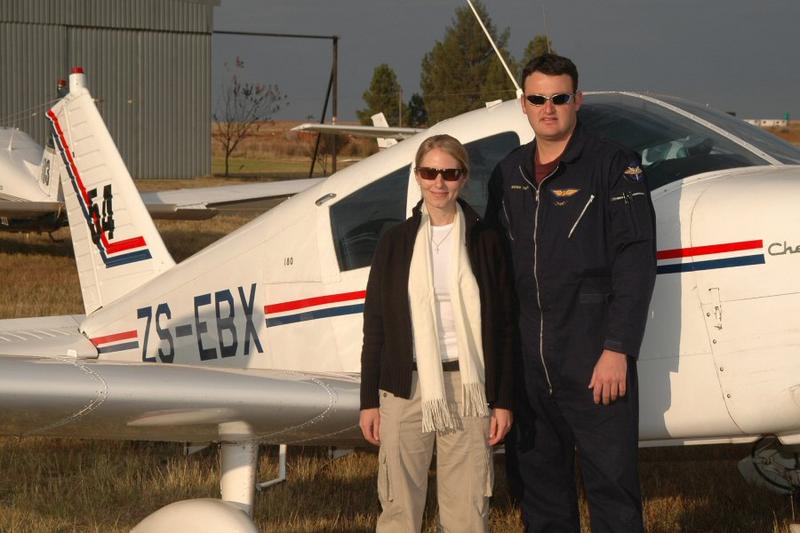
Race 54 Crew - Viv and Nasser
Race 54 Crew – Viv and Nasser

The Monday preceding the air race, we found out that our little aeroplane would not be ready in time, due to it having been for an engine overhaul, and still needing a few parts. People were phoned, pleas were posted on Avcom, and eventually we came across a flight school that was willing to hire out their Cherokee 180 to us…. Check rides were done, documents filled in, we were sorted.

Thursday morning arrived, and while preflighting, we realized that the rotating beacon was not working, and a replacement bulb wasn’t available. Not a huge dilemma, so we set off on our journey to New Tempe. En route, our intercom decided to cease functioning properly and didn’t allow communication to occur from pilot to co-pilot, obviously a problem in a race situation. No problem. We continued being confident that we would be able to sort something out once in Tempe.

At Tempe we organized the loan of another intercom (thanks George), got down to the business of attempting to clean the aircraft for the extra streamlining of our aircraft, and then attended the briefing which exposed the route of Day 1. Tempe – Tierpoort Dam – Barkley East – Springfontein – Tempe. Seemed easy enough. We plotted our navigation – the obvious lack of waypoints along one particular leg became apparent, namely the Tierpoort Dam – Barkley East leg.

Friday morning we took off at the prompt of the green light. First turning point was found easily, and then we turned onto our planned heading for the second leg. By this stage there were no other aeroplanes in sight. On turning onto the heading, it became apparent that the magnetic compass was not behaving as it should be, but was instead spinning non-stop. Not the end of the world, so we continued unperturbed.

The turbulence was unlike any I’ve ever experienced, (I now have countless bruises all over my body as the temporary evidence thereof), and after about 10 minutes into the second leg, a big bump caused me to lose hold of the stopwatch. After frantically searching for the stopwatch myself, Werner decided to give me control, unstrapped himself and jumped to the back to look for the stopwatch himself – that didn’t turn out to be such a productive move. The stopwatch was eventually located, although the digits on it no longer held any significance…..

We continued along on our merry way.

Race 54 - ZS-EBX
Race 54 – ZS-EBX

By this stage, we seemed to locate ourselves on the map, and things still made sense, but that didn’t continue for long. Soon, there were just too many hills and too many lakes, none of which appeared on the map.

While doing the nav planning, we had very unwisely cut away all irrelevant, (supposed to be), parts of the 1:250 000 maps we had, only to leave the planned route. (Big mistake if there are any big deviations in track, which proved to be our situation.)

Instead of panicking, we took the calm approach and just continued along, not really taking any decisive action, probably hoping, (and praying), that Barkley East would just somehow miraculously appear!

Just before two hours total time elapsed, Nasser casually said that we should look at a contingency plan: one that included finding out where we were. This is when Nasser decided to heed a friend’s advice as to what to do when lost (or temporarily unaware of your location). Fly low-level along a road and read the road signs. (Needless to say this friend is a chopper pilot!)

King Wiliiam’s Town 54 km
Bisho 69km

So it had seemed we may have gone just a bit too far south. Ok, not just a bit, more than twice as far as we were supposed to have! Luckily Nasser had done his PPL training down south, so he had situational awareness to his advantage, and decided to head to Bisho, where he knew there was a nice, big accommodating runway waiting just for us.

After landing at Bisho, we made our way to the ATC tower, where we got a bewildered welcome from two ATCs, playing cards. They had not even realised that we had arrived, (don’t worry, we did join and land procedurally!), and when we asked them whether they had some maps to help us plan our way back, they pointed to the large, faded map of Africa on the wall. That was not going to help us!

After making contact with a rather surprised fellow PTAR competitor, it was ascertained that with the headwind now being as strong as it was, there was no way we’d make it back to Tempe with the fuel we had left, and there was none available at Bisho. Not being too far away, Port Alfred seemed the next logical stop for us, as Nasser had friends there who were willing to assist us, and there was fuel aplenty. So off we went, (after paying our landing fees of course), experienced my first low-level flight at the coast and then landed on runway 25 at Port Alfred.

Once there our embarrassing story had to be told to many amused people, but we managed to get the maps we needed, as well as GPS as back-up since our navigating-by-map-skills had obviously much to be desired.

Off we traipsed to our aircraft, where we were greeted by a girl holding one of our wheel spats- in lots of small pieces. The consequence of what seemed to have been a very soft landing; how that happened still baffles us to this day….

So off we went back to New Tempe, by which stage the sun was already setting, which proved a good opportunity for Nasser to log some night-flying hours. After several attempts to contact Cape Town East Information were made to no avail, they eventually contacted us, and informed us that they had been made aware of our “situation”, even so, the ATC was incredibly helpful and friendly, and was very welcome in our time of distress. Nightfall arrived, and when switching on the cabin lights, we were dismayed, (but not entirely surprised), to find that they were not working. So using an alternative source of lighting, we continued our flight to New Tempe: Nasser controlling the plane, speaking to Information intermittently, and me, securing the “alternative source of lighting”, and controlling the cabin heat airflow. (It was freezing at FL095.)
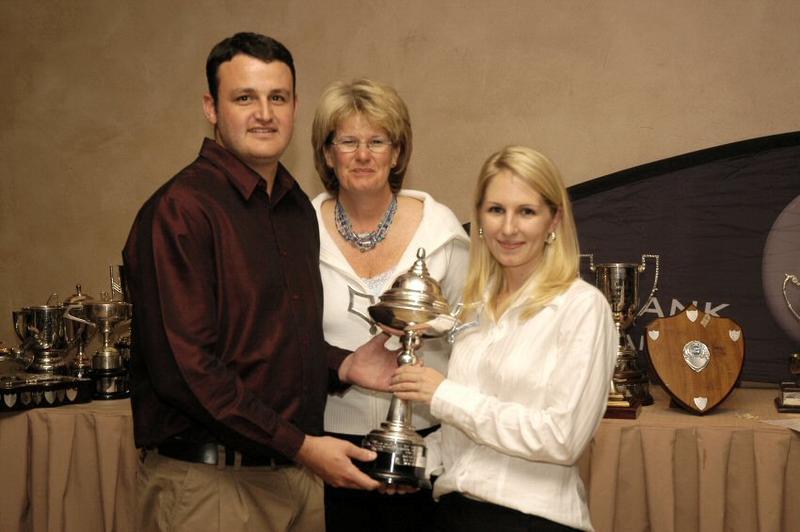
President's Trophy Air Race - Stayers Trophy
Winners of the Stayers Trophy – Nasser and Viv with Denise Booysen

We landed at Tempe at approximately seven o’clock that night, a considerable few hours later than most competitors, by which stage we were completely exhausted. The first day of PTAR had proven to be more eventful than we had expected a real comedy of errors!

We decided to participate in Day Two of the race, even though we had now been disqualified. It turned out to be thoroughly enjoyable, and I’m happy to report that we never came across any overtly large bodies of water, so there IS hope for us!

At the ceremony, we were awarded “THE STAYERS TROPHY”, and a lot of laughs were had on our behalf, but it was all in good fun, and we were commended on how well we handled our situation by many of the PTAR competitors, really wonderful people – just one of the many reasons participating in PTAR is such an awesome experience.

After an experience like ours, there are the “how’s” and “why didn’t you’s” asked by others and ourselves, and we admit that mistakes were made, but at least we enjoyed making them, and I think it’s safe to say that this has been a huge learning curve for us, as well as a memorable experience, which we will not forget very quickly. (If we do eventually forget, there will definitely be someone there to remind us!)

Look out PTAR 2006, here we come!

Imperial Bank LogoImperial Bank Logo

2005 Imperial Bank President’s Trophy Air Race

Held at Tempe, Bloemfontein – 26 to 28 May 2005

Analysis of Logger Tracks

By Chris Booysen

Air Observer GPS loggers were used both for the test flying of aircraft with inadequate history as well as being fitted to aircraft in the race on both race days. SAPFA has approximately 20 loggers and so 20 aircraft were logged each day. 13 aircraft were logged on both days.

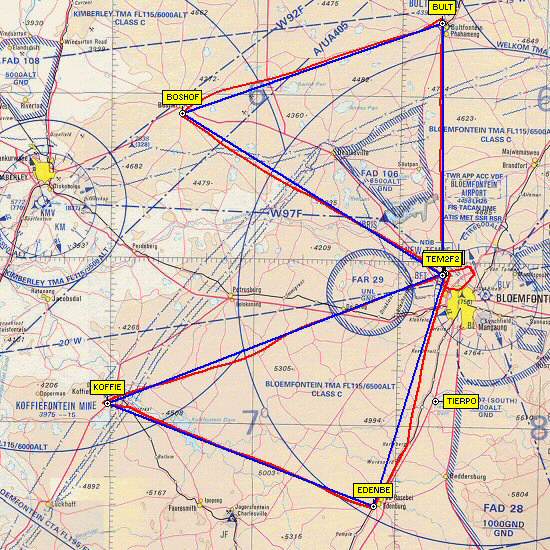
Where is Springfontein?

The loggers record the longitude and latitude and altitude every second, in other words the three dimensional position of the aircraft every second. Using these plotted positions the software can calculate the heading, climb/decent and ground speed of the aircraft. In addition the actual distance flown each day is calculated by the software

What is important to note is that there are a number of factors that affect the speed achieved by an aircraft. There is the inherent speed of the aircraft and the crew ability. The crew can increase the overall speed by flying in a straight line, using the winds, climbing and descending at the correct speeds and flying the aircraft in the most aerodynamic configuration (ie as “smoothly” as possible). Handicaps are set to remove the differences in the inherent speed of the aircraft and not the crew ability. GPS logging of aircraft can give an indication as to the accuracy of the flight. It can also give some indication of the usage of winds but it cannot give any indication of how well the aircraft was flown by the pilot. For example, it is impossible to detect a pilot that provides constant control input on the horizontal and vertical plain by means od a logger download. Constant input increase drag and reduces speed.

Race 67 - ZS-OWS improving as they go
Race 67 – ZS-OWS improving as they go

It is still the intention of SAPFA to purchase additional GPS loggers out of any surplus made at the Air Race until we are in the position to fit a logger in each aircraft.

On both days of the race there was a strong North Westerly wind. An analysis of the logger tracks shows that it was essential to climb as early as possible and as high as possible on the leg from Tierpoort Dam to Barkley East. Aircraft that climbed quickly to 10 000 ft gained approximately 40 knots when compared with the average speed they achieved in the next two legs back to Tempe into the headwind. Those aircraft that climbed slowly only gained about 36 knots while those that stayed low gained far less.
A table of the information gathered from the aircraft logged for both days is set out below.

Dieter Bock (Race 56 - ZU-APZ) showing that an off-course error does not cost much if handled correctly.
Dieter Bock (Race 56 – ZU-APZ) showing that an off-course error does not cost much if handled correctly.

The tracks flown on Day 1 by logged aircraft were fairly accurate with the exception of two aircraft that got lost. One flew past Tierpoort Dam, almost to Edenburg and the took approximately 35 minutes to find the dam. Another aircraft flew to the right of the mast at Springfontein and missed it. That aircraft flew approximately 120 NM until they eventually found the station (see top map).

The tracks flown on Day 2 were also flown fairly accurately. The leg from Koffiefontein back to Tempe seemed to catch most participants as that leg showed the largest deviation by most aircraft.

On an overall basis the shortest distance (of aircraft logged) was flown by Race 56 – ZU-APZ flown by Dieter Bock and Mark Steyn and the second shortest distance by Race 5- ZS-KSZ flown by Wally and George Brink. These competitors were placed 52nd and 53rd respectively. As mentioned above there are other factors that affect the speed of an aircraft but both these teams are experienced and their positions must be (at least partly) due to a harsh handicap. The Day 2 track of Dieter Bock shows that it is possible to go off course and still remain competitive. The correction when off track must be done to intercept the track at the next turning point.

It is interesting to note that the additional distances flown this year were greater than last year. Last year the winner was logged and only flew 2.4 miles over the two days racing. As the 2005 winner was not logged on Day 1 we do not have a comparison. The aircraft in 3rd (Race 104 Chris Briers and Jack Onderstall) and 5th position (Dave Mandel and Rod Crichton) in 2005 were logged and flew additional distances of 5.99 NM and 7.27 NM respectively.

A number of GPS loggers had problems. There were instances of loggers that were turned on late which meant that the software could not calculate the accurate distance flown. There was one instance where the logger lost satellite reception, one instance where the logger was turned off by the crew (after getting lost) and one instance where the logger failed to download any information.


Logger data – aircraft fitted with loggers for both days

Race
No
Pos Distance Flown
Day 1
Additional Distance
Day 1
Altitude on B/East leg Remarks Distance Flown
Day 2
Additional Distance
Day 2
Additional
Distance Race
Remarks
1 20 330.58 2.63 10 000 Cruise climb 319.54 5.49 8.12 None
5 53 330.54 2.59 9 000 Fast climb 316.58 2.53 5.12 None
8 65 331.02 3.07 9 000 Cruise climb 324.54 10.49 13.56 None
23 5 330.08 2.13 8 500 Steep climb 319.19 5.14 7.27 None
26 40 329.29 1.44 8 500 Fast climb 321.34 7.29 8.73 Shortest Day 1 Track
32 63 336.70 8.75 10 000 Cruise climb 319.16 5.11 13.86 None
38 47 331.43 3.48 6 000 Cruise climb 316.41 3.36 5.84 None
50 26 329.84 1.89 9 000 Fast climb 326.61 12.56 14.45 Antennae not unwrapped.
Inadequate satellite reception
on day 2.
Visual inspection of the track
indicates a far more accurate flight
51 44 332.19 4.24 8 500 Slow climb 318.17 4.12 8.36 None
56 52 329.96 2.01 8 500 Slow climb
Cost some minutes
317.02 2.97 4.98 Shortest track for race. Did not make full use of tailwinds
60 54 333.88 5.93 9 500 Fast climb 318.68 4.63 10.56 None
65 41 331.89 3.94 9 500 Cruise climb 318.08 4.03 7.97 None
104 3 330.94 2.99 8 000 Fast climb (stepped to 7000 first) 317.05 3.00 5.99 Day 2 distance estimated as logging only started during leg 1

Wings ‘n Tracks National Precision Flying Championships

Brits, South Africa – 28 to 29 April 2005.

By Adrian Pilling

Wednesday, 27 April

Competitors at the 2005 National Precision Flying Championships
Competitors and Officials.

The public holiday allowed some of the crews to arrive in time for the National Championships. Crews flew in from as far away as Durban and Port Elizabeth.

The enthusiastic town of Brits was the host to this prestigious event, again. This town is truly amazing as the marshals and all the officials are so dedicated to this sport that quite literally if they did not do what they did the sport would battle to survive. Thanks guys and gals.

The evening briefing was fun with most of the crews settling down for the night. However one of the crews, Nigel Hopkins, was still flying the Boeing back from Bombay and we were not sure he could make it.

Thursday, 28 April

The day dawned, cold and a little hazy. The first off for the day was Adrian Pilling, into flight planning at 8am. The rest of the crews followed with Nigel Hopkins racing across form Jhb International to make the competition and Frank Eckard arriving in time to join too.

Ron and Mauritz in the classroom.

The route was tough but fair. One mishap however got the competitors talking amongst themselves is that Mary de Klerk forgot to put her logger in the plane and in doing so scored maximum penalties for the day (OOOOOPS). The route featured 12 photos, 4 ground markers and 9 legs. A deceptive route to say the least.

The Competition was scored swiftly and accurately and before the evening meal was served by the Brits supporters, the results were out. 1st Place Nigel Hopkins, 2nd Place Barry de Groot, 3rd Place Adrian Pilling, 4th Place Jan Hanekom, 5th Frank Eckard, 6th Place Ron Stirk, 7th Place Hans Schwebel, 8th Place Ernie Alexander, 9th Place Mauritz Due Plessis, 10th Place Walter Walle, 11th Place Mary de Klerk (due to the logger story, otherwise Mary would have been 5th).

A great evening was had by all and after much merrymaking the crews retired for the night and prepared for the coming battle.

Friday, 29 April

Landing Champion – Adrian Pilling receiving his trophy from sponsor Barbara Friebose.

The day started with a bright and sunny morning and the usual Brits enthusiasm had everybody panting with anticipation for the coming competition. The start order was the same as yesterday with Adrian taking off first.

The route was again a deceptively simple route around the province, featuring much difficult terrain and difficult photographs, a typical tough Brits competition.

The day proved challenging with many mishaps occurring. Adrian had a problem with his logger which failed to record the flight and as a result scored maximum (OOPS), Nigel had a mishap in flight planning scoring maximum (OOPS).

2005 South African Precision Flying Champion - Nigel Hopkins
2005 S A Precision Flying Champion – Nigel Hopkins.

At the end of the navigation section the scores were neck and neck with Barry de Groot and Nigel Hopkins equal on 539 penalties each and everything to fly for with the landing competition in front of them.

The landings produced their own set of dramas with Ron Stirk clearly in the lead, but scoring a skip and putting him down the field (OOPS). Then with Barry slightly in the lead over Nigel and with one landing to go, Barry executed a perfect landing and was clearly set to pip Nigel at the post when it was discovered that he had taken off with ten degrees of flaps and had forgotten to remove them for the final landing and in so doing scoring maximum for this landing (OOPS), thus handing the championship to Nigel. Wow what a nail biting finish for the competitors.

Adrian won the landing competition thus making up somewhat for the logger problem earlier in the day.

That evening the competitors waited in eager anticipation for the results. A huge braai was enjoyed by all and then down to business. The final results were:-

2005 South African Precision Flying Squad
National Precision Flying Squad L to R – Jan Hanekom, Ernie Alexander, Ron Stirk, Adrian Pilling, Nigel Hopkins, Mary de Klerk, Barry de Groot, Hans Schwebel and Chris Booysen (Manager).

  • 1 Nigel Hopkins 583
  • 2 Jan Hanekom 635
  • 3 Hans Schwebel 670
  • 4 Ron Stirk 760
  • 5 Barry de Groot 772
  • 6 Frank Eckard 938
  • 7 Ernie Alexander 1509
  • 8 Walter Walle 1909
  • 9 Mauritz Du Plessis 2406
  • 10 Adrian Pilling ** 3387
  • 11 Mary de Klerk ** 3452

What’s more the provisional squad to the World Championships in France next year was announced. The squad comprises:- Hopkins, Pilling, Hanekom, de Klerk, Schwebel, Stirk, de Groot, Alexander. Well done to you all.

Thank you to the following for a great event. The Competition Director and Chief Judge was Chris Booysen ably assisted by his wife Denise. The Jury comprised Dicky Swanepoel, Thys Herman and Tony Peeters. The Chief Marshall was Jacques Jacobs. The Safety Officer was Ruben Knotze. The Route Planner was Deon Van Den Berg. The Fuel Officer was Paul Hermann. Of course a big thanks to the Brits Flying Club and all the supporters for their very hard work. A special thank you to Wings n’ Tracks for their sponsorship and of course to the marshals for all their hard work.

Thank you all.

Wings ‘n Tracks National Precision Flying Championships – Brits 2005 – Detailed Results

Day One Day Two Land Grand
Pos Name The Mkrs Photo Flight Other Tot The Mkrs Photo Flight Other Tot Total Total
1 Nigel Hopkins 0 20 20 57 0 97 350 20 60 12 0 442 44 583
2 Jan Hanekom 1 20 60 201 0 282 0 20 70 207 0 297 56 635
3 Hans Schwebel 0 0 120 336 0 456 0 0 40 123 0 163 51 670
4 Ron Stirk 7 20 60 306 0 393 0 20 120 144 0 284 83 760
5 Barry de Groot 1 20 140 66 0 227 0 20 100 192 0 312 233 772
6 Frank Eckard 94 20 60 177 0 351 0 90 100 195 0 385 202 938
7 Ernie Alexander 12 40 100 725 0 877 0 40 170 291 0 501 131 1509
8 Walter Walle 0 40 80 855 0 975 6 40 160 527 0 733 201 1909
9 Mauritz Du Plessis 4 40 160 770 0 974 0 40 140 943 0 1123 309 2406
10 Adrian Pilling ** 0 40 60 156 0 256 0 20 80 3000 0 3100 31 3387
11 Mary de Klerk ** 0 40 60 3000 0 3100 0 0 80 210 0 290 62 3452
Max score 350 80 240 2000 0 2670 350 100 240 3000 0 3690 1200 7560
** Note
 – M de Klerk was penalised 2 768 penalties due having to return to the field after take-off to collect a logger
 – A Pilling had a logger failure on Day 2 resulting in the allocation of maximim flight penalties


More Pictures of the National Precision Flying Championships
Click to enlarge
Jacques Jacobs and Walter Walle
Jacques and Walter
C172 - ZU-AFP
Marshall at AFP
2005 Precision Jury
2005 Precision Jury
Jacques Jacobs
Jacques Jacobs – Chief Marshall
Landing Marshals
Landing Marshals
Maurits landing ZS-MAE
Maurits landing ZS-MAE.
Landing competition 2005 spectators
Landing competition spectators
Jan Hanekom landing ZU-CNG
Barbara - Event Sponsor
Barbara – Event Sponsor
Nigel and Barry
Nigel and Barry
Hans Schwebel - 3rd Place
Hans Schwebel – 3rd Place
Jan Hanekom - 2nd Place
Jan Hanekom – 2nd Place
South African NationalPrecision Flying Logo