Air BP Logo

WORLD FLYING CHAMPIONSHIPS – 2004

Incorporating the 14th World Rally Flying Championships,
and the 16th World Precision Flying Championships

Herning, Denmark – 14 to 24 July 2004.

By Chris Booysen

Part 1 – The Practice

The Air BP SA Flying Team departed from Johannesburg International on Thursday 8 July. After the long flight via Amsterdam (Frankfurt and London for some of the team) all arrived in Herning. After a quick shower the recce squad drove out to the airfield to see what was in progress. The French team had arrived the previous day and were practising. The UK and Polish teams arrived during the afternoon.

Only one aircraft was available so it was decided that the team would take the night off and start in earnest in the morning. The night was spent with some team building and the team went to bed early – or so we thought as we were back at the hotel before sunset at approx 11:00 pm

Saturday, 10 July

2004 World Flying Championships -Herning
Jacques Jacobs, Chris Booysen, Walter Walle, Hans Schwebel and Ron Stirk sorting out the loggers

By 8:30 all the team were at the airport. We only received one of the aircraft, and this one with a flat oleo. The rest of our aircraft were supposed to arrive but the weather to the North was not good. Only the deliveries of aircraft from the South could take place. We were kept busy with initialising the loggers and plotting the practice route for the day. As the day progressed the weather got worse. Frank Eckard and Quentin Taylor managed to fly the practice route (at 300 ft AGL) and Walter Walle and Ron Stirk had an interesting flight after flying the owner of the aircraft he was using home. Chris Booysen took Jan Hanekom and Hugo Stark (by car) on an aborted attempt to collect an aircraft at Viborg. By 14:00 it was raining over the whole area so we called it a day and went back to the hotel.

Once again we made some (special) friends at the local pub – especially our judge observer – Jacques.

Lets hope it clears tomorrow!

Sunday, 11 July

2004 World Flying Championships - Practice conditions
Jan Hanekom and Hugo Stark flying in the rainy conditions.

The weather has cleared a bit – still a low cloud base and a temperature of in the low teens. We managed to get all teams to fly at least one practice route. Timing and navigation seems fine but all are battling with finding photos. Most teams have only found one or two photos per route. Frank and Quentin flew the same route again and this time managed to get the photo count up significantly. Still not good enough but if we improve at this rate we will be fine. The maps are extremely accurate but are road maps so do not have some features on them eg. power lines. The wind power generators are also not normally marked – but there are so many they are not good navigational features.

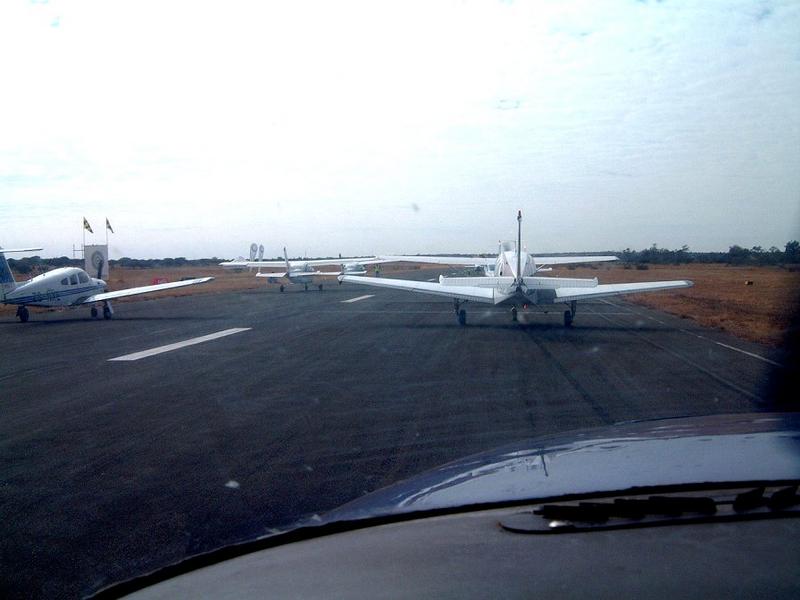
Most teams from the other participating countries have arrived so it is getting busier at the Herning airport. At one stage finals looked like Heathrow with 3 or four aircraft on finals appearing out of the gloom.

Some humour was added today when Ernie Alexander and Mike Ehrman went for their first flight. Ernie was battling a bit with the unfamiliar radio and was calling Herning Tower. Eventually he heard a reply “Ernie – can you hear me” Ernie replied – “Yes – where are you?” “Sitting right next to you” says Mike.

Monday, 12 July

Mike Ehrman plotting a practice rally
Mike Ehrman plotting a practice rally.

The weather reminds me of Port Elizabeth in winter, overcast with wind 290/25G29knots, and it is supposed to be the middle of summer in Denmark. At least the cloudbase has lifted which allowed some more serious practice.

Nigel Hopkins and Dale de Klerk joined the team today. For them, an eventful flight with Nigel arriving with some luggage missing. At least he now knows what it is like to sit in the back!

The practicing is starting to have some effect and we are now finding far more photos. We also have all our aircraft at last so we are more settled. The wind is causing a problem on the downwind legs but the organisers will probably be working a wind factor into the planning which will make most teams happy.

Our main competitors, the French and Polish teams are putting in some serious practice. We will have to pull out all the stops to retain out status as World Champions.

Tuesday, 13 July

Up early today as Ron and Hans wanted to practice without major traffic. When we arrived at the airfield at 6:30 we realised that it would not be fun today. The cloud base has increased to approx 2 500ft AGL but the wind speed has increased. The official wind at the airfield was 25G30 but at 1000 feet he wind was more like 35 to 40 knots. After our experience of the previous day wind was taken into account when calculating times so that it was easier to maintain time

We have made up two new routes and flown them taking photos. The photos for the routes that Nigel brought back from the Danish Nationals have already aged. The colours are all different and that is why we are struggling with photo recognition. Times and number of photos spotted is improving flight by flight.

Wednesday, 14 July

2004 Worls Flying Championships - Opening Parade
Opening Parade – Herning.

Not a very active day today. Hans, Ron and a few others were at the airfield at 6:30 to practice some landings. After that we had the first official briefing at 9:30 followed by lunch and then back to the hotel. The weather has closed in and it is raining again. We marched through the city center of Herning to the town hall in the rain. After a few speeches and the flag raising we were entertained by the Herning City Council. The food here is outstanding. Snacks and free beer made it difficult to leave but tonight will be an early one so we can be prepared for the official practice tomorrow.

The weather forecast for tomorrow is good but then deteriorating from Friday again. Hopefully we will get in enough flying to make it an official competition.


Thursday, 15 July

Jacques Jacobs – Judge Observer with Mike Ehrman

The official practice was held today. The field has been divided into two with three of our teams in each group.

The official practice is a dry run and is run according to the rules. At the marshals briefing it was recognised that Jacques Jacobs, our Judge Observer, was one of the most qualified so he was appointed to do the debriefing. This has only added to the permanent smile Jacques has had since leaving Johannesburg.

Once again the weather was poor and some of our teams battled in poor visibility. Overall the results were not what we have hoped for and a few silly mistakes need to be eliminated. Rather in the practice than in the event. Nigel and Dale did well with 18 timing penalty points but slipped up a bit on the photos. Hans managed to “Bingo” the landing so we have some positives for tomorrow.

The good news is that the weather is clearing and we now have all the aircraft for both events. As it is a dual event there is practicing allowed by the precision pilots during the rally event. Walter at last managed to get some practice in today even though he had lent most of his equipment to other members of the team.


Pictures taken by various team members
Herning Airfield
Herning Airfield
Hans Schwebel checking his mail
Hans
Jan Hanekom and Hugo Stark
Jan and Hugo
Herning Airfield - Finals
Finals clear
Herning Airfield - Finals
Finals rain
Hotel Eyde
Hotel Eyde
2004 World Flying Championships Herning
Ready for opening
2004 World Flying Championships - Opening Function
Opening Function
Frank Eckard
Frank Practicing
Walter Walle
Walter Walle
2004 World Flying Championships Post mortem
Postmortem of practice
Blue Sky at Herning
Blue Sky at last!

South African Rally and Precision Flying Team Logo

World Flying Championships - Denmark logo

Executive Turbine logo

President´s Trophy Air Race

Pietersburg Civil, Polokwane – 10 to 12 June 2004

By Chris Booysen

Pietersburg Civil Airfield

The 2004 President’s Air Race was run from the Pietersburg Civil Airfield (FAPI). The change of venue from Tempe was a refreshing one. While it was a long trip to get to Pietersburg for a large number of competitors the flight was worthwhile. The change of venue also introduced the race to a number of new competitors from the far north of the country. I am sure the majority of these participants will become as hooked on the race as I am. Organisers Chris and Dries Briers had proposed some drastic amendments to the format of the race. These included a major reshuffle of the handicaps with most being reduced, the attempt to give some real benefit to sponsors and reduce the vast and growing number of trophies that were awarded.

A large cold front had passed over the country a few days before the race so the forecast for the flight up, both race days and the return flight was good with a high pressure cell over most of the country.

For those that have entered the race before pre-race day was a routine event with arrival, efficient registration with Antionette from Naturelink, refueling and scrutineering. Test flights were compulsory for non standard aircraft. The refueling was also a pleasure with the Naturelink “valets” parking the aircraft for you. This also enhanced safety as there were very few turning props in the parking area. Unfortunately we arrived just after Race 25, the Piaggio Albatros of the Marx brothers which meant there was a considerable delay in the fuelling. At one stage I was worried that they would use all the fuel in the underground tanks. After all this was handled it was off to the hotel to grab a few minutes of shut eye (or a few beers) before the briefing at 6:00pm

Roaul du Plessis & Dawid Viljoen - spot the team member that cleans the top of the wings
Roaul du Plessis & Dawid Viljoen – spot the team member that cleans the top of the wings

The organisers were pulling their hair out with the large number of late entries and arrivals. I know that the last entry posted on the internet site was received on Wednesday evening. Although the rules state that aircraft need to be parked an refueled before 12:00 aircraft were still arriving after dark during the briefing.

Briefing started at 6:00 as promised and covered the normal welcome, safety issues, procedures, weather, ATC, start and the route for Friday. This would take the crews from Pietersburg to Giyani (74,5 miles), Messina (66,9 miles), Alldays (55 miles), Mokopane (formerly Potgietersrus – 93,5 miles) and then home to Pietersburg (33,2 miles). Pictures of all turning points were provided. Some very generous sponsored prizes were drawn in a lucky draw. These included vouchers of R5 000, fuel for the race paid and some “goodie bags”.

After the briefing supper was provided and then most crews rushed off to plot and study the route. The main discussion in our hotel was the options on the Alldays-Mokopane leg. A decision had to be made whether to go over or around the large mountain that someone had put directly on track. Consensus was that the best option was probably to go right of the mountain down the valley but we decided to wait and see when we got there.

Turning Point 1 Day 2

Race Day 1 dawned with temperatures that reminded us of Tempe. No surface wind to speak of but a light easterly at about 7000 feet. This immediately started the debate on the necessity to climb on the Messina-Alldays leg and make use of the tail wind. We were also kind enough to show Race 5 (George and Wally Brink) the two mines on the first leg just before Giyani that were not marked on their 1:500 000 map. These mines would make it simple to find the Giyani field as you had to fly directly over both just before the turning point.

Aircraft engines were started 15 minutes before the take of time. This might seem a long time but before you know it you are at the starting robot waiting for the green. Aircraft were launched at 30 second intervals with the fastest aircraft off first. There were 70 aircraft on the start list, proof that the race is maintaining its popularity. Much to our disgust the DI precessed about 20º to the left after take off putting us off track immediately. Luckily the railway line was a dead give away and after cursing the AMO who serviced our DI we continued using more navigation and the compass. A few minutes later we realised that the lack of vacuum might be the cause and turned on the standby vacuum pump. Much to our disgust there was no sign of any mines and we almost missed the Giyani turning point. A number of other aircraft were not as lucky as when they popped over the mountain at Giyani the turning point was covered by a small cloud that made it invisible. At one stage there were three aircraft circling over the turning point but unable to see it. Race 23 (Dave Mandel and Rod Crichton) wasted at least four minutes looking for that red cone.

Enroute Scenery
Enroute Scenery

The route between Giyani and Messina required a small climb over some mountains. At this stage a few aircraft became visible and we had the frustration of an aircraft with a lower handicap breezing past us. Dare I mention the handicapping now!!! Between Messina and Alldays the scenery was incredible. The “bosveld” at its best with thousands of enormous baobab trees.

After Alldays there was a large mountain to get over so the climb was started immediately. The view of the mountain cliffs was incredible. Once over that mountain the discussion of the previous night became irrelevant as it was obvious that the best option was to start a slow descent and pass to the right of the high mountain. Most aircraft chose this option. A notable exception was Race 4 (Jacques Vercueil and Chris Spencer-Scarr) who decided that the mountain was not marked on their map and that they would have to turn more and more to the left to get onto track. Once past the mountain there were enough features to make the run down the valley into Mokopane a straight forward affair.

Enroute Scenery
Enroute Scenery

After Mokopane the left turn took the aircraft back to Pietersburg. To avoid a big climb the best track was up the highway through the kloof. Thank heavens the power lines were well marked or there could have been an incident – or as we were told at the briefing “You could pick up some copper”. Pietersburg runway is visible from a distance and so the last leg could be enjoyed by both the pilot and navigator.

Results handed out for the first day showed Race 52 (Jay Bartholomew and Lawrence Bettesworth in a Cessna C172) in the lead followed by Race 30 (Harry Antel and Barry de Groot in a Grumman), Race 53 (Nico van den Berg and Johan Rautenbach in a Cessna C172) and Race 43 (Adrian Tomaz and Llewellyn Potgieter in a SAAF Cessna 185). An error in the original handicap dropped Race 52 down the listing and the team of Antel and de Groot therefore took line honours for Day 1.

The briefing was a repeat of the Day 1 event with emphasis on the circuit procedures that would become critical at the end of Day 2. Some transgressions of the first days briefing were noted but no penalties were applied. Once again all waited for the important announcement of the route for the next day. The route started with a short leg to Tzaneen (46.5 miles), then to Lydenberg (76.8 miles), across to Warmbaths (114.5 miles) and then back home to Pietersburg (87.7 miles). The distance totaling 326.4 miles. What worried the contestants was the grin on the faces of Dries and Chris Briers when they announced the route. Once again clear colour pictures were given of each turning point. After the briefing the evening meal was again supplied courtesy of the sponsors. Provisional start times were handed out but these were subject to change due to the correction of some handicaps.

Start line up on Day 2

Back at the hotel the reason for the smile on the route planners faces was apparent. While the first leg was similar to Day 1 the second leg took the aircraft over some enormous mountains. Also immediately after the turn at Lydenburg was a few contour lines that were very close indicating a quick climb over the mountains again. The long leg to Warmbaths (Warmbad/Bellabella??) had enough good navigation points to make sure that one did not get too lost. The last leg home paralleled the main road so would also not be too difficult.

Race Day 2 dawned with some high cloud cover and little wind to speak of. Winds at most altitudes were a light 3 knots – not a major factor for the days racing.

The start times for Day 2 are determined with a finish time of 13:00. If you fly at exactly your handicap speed for both days then you will finish exactly at 13:00. If you gained a minute on day one then your take off time would be determined by the time you need, at handicap speed, to cross the finish line at 12:59. This method can result in very close take off times. For example Race 38 and Race 19 took off only 3 seconds apart. While this sounds scary to new race participants the distance between the aircraft only increases on the take off roll. In fact, by the end of the runway the crew in the aircraft behind tend to feel if they did not start quick enough

Last leg on Day 2
Last leg on Day 2

On Day 2 it becomes apparent on how important it is to do well on the first day. It is very disconcerting seeing aircraft with handicap speeds equal or greater than yours taking off earlier than you. You know you will never see them until the end unless they get lost. This method means that the bulk of the slowest aircraft take off first. It is also not a good feeling seeing aircraft taking off an hour before your start time.

The first leg to Tzaneen was similar to Day 1. The heading was only a bit greater. The turning point was well hidden behind a hill making for some sharp action to make sure you cleared the red cone shaped beacon. Then the big climb over the Drakensberg. The scenery was stunning and the navigation fairly easy as in the zero wind conditions it was a simple “stay on heading” type of exercise. Some local knowledge made homing in to the airfield at Lydenburg an straight forward affair and then a steep turn and into the climb over the mountain. We turned with two other aircraft and each headed off in a different direction. When this happens the normal discussion with the navigator starts with predictable results. “Of course they are wrong and we are right!” – (I only wished we were the middle aircraft).

PTAR 2004 Medalists From L to R: Wessel Vermaas, Pieter Lordan, Harry Antel, Barry de Groot, Johan Rautenbach and Ni

The “2 minute” calls now start indicating that the field is starting to bunch. The adrenaline starts pumping and you start willing the aircraft to fly faster. The calm was suddenly shattered by a Mayday call. Race 43 was doing a forced landing with engine trouble. There are immediate calls asking if they need assistance (how?) but indicated they would phone Race Control when they are safely on the ground. While on the subject of radio calls the low point of the race was some disgusting comments broadcast by one of the race participants. Unfortunately the culprit was protected by the anonymity of a radio broadcast.

The turn at Warmbaths required some care as it was approximately 130º and the traffic was getting more dense. Normally the last leg is busy. Just after Warmbaths we passed a gaggle of Cherokee 140’s and other slower aircraft and then seemed to hit a “bare” patch and do not see any slower aircraft. Once again the question to the navigator as to his ability and once again the predictable reply.

PTAR 2004 Winners - Harry Antel and Barry de Groot
PTAR 2004 Winners – Harry Antel and Barry de Groot

The last leg was a little more difficult than indicated on the map as the main road was not really close enough to help for accurate navigation. The little rivers, farm houses and roads etc had to be used to keep perfectly on track. Pietersburg runway came into view fairly far off and then it was over to the aircraft to make sure you passed more aircraft than passed you. The circuit was busy approximately 20 aircraft in the circuit at any time. By following the briefing instructions, ie keep approximately 100 knots and space yourself, meant that the whole procedure was safe and efficient.

Day 2 (only) saw Race 30 (Antel and de Groot) in the lead, followed by Race 53 (Nico van den Berg and Johan Rautenbach) and Race 19 (Sean Hughes and Harry Moos). This mean that Harry Antel and Barry de Groot were first overall followed by Nico van den Berg and Johan Rautenbach. Third overall was Race 38 piloted by Wessel Vermaas and navigated by Pieter Lordan.

The banquet was a smart affair at the Casino in Polokwane. Speeches were made by dignitaries and sponsors and the appropriate thank-you’s were made. The Awards were presented to the top three teams and other deserving participants. The number of awards was limited as promised by the organisers.

The overall conclusion? A Great Race!!! The venue, the organisation, routes and functions were fantastic. The handicaps – the jury is still out in that one. See you all again next year.

Day 1

From To Distance
Nm
Cumulative
Distance
Polokwane Giyani 74.5 74.5
Giyani Mussina 66.9 141.4
Mussina Alldays 55.0 196.4
Alldays Mokopane 93.5 289.9
Mokopane Polokwane 33.2 323.1

Day 2

From To Distance
Nm
Cumulative
Distance
Polokwane Tzaneen 46.5 46.5
Tzaneen Lydenburg 76.8 123.3
Lydenburg Warmbaths 115.4 238.7
Warmbaths Polokwane 87.7 326.4

Total Distance – 649.50 Nautical Miles


Attachment Size
2004_ptar_route.kmz 1.23 KB