2001 President’s Trophy Air Race – Picture gallery
2001-08-09
2001 PTAR – Picture gallery


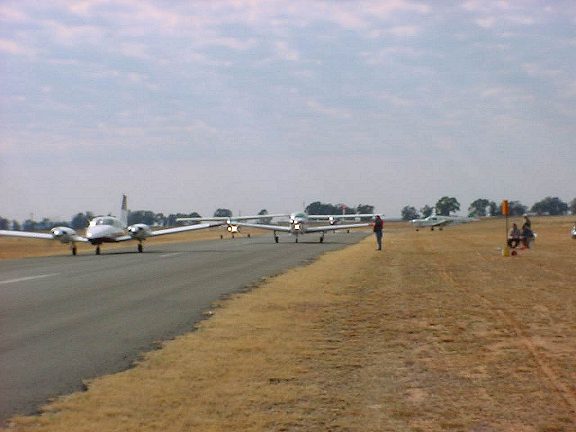
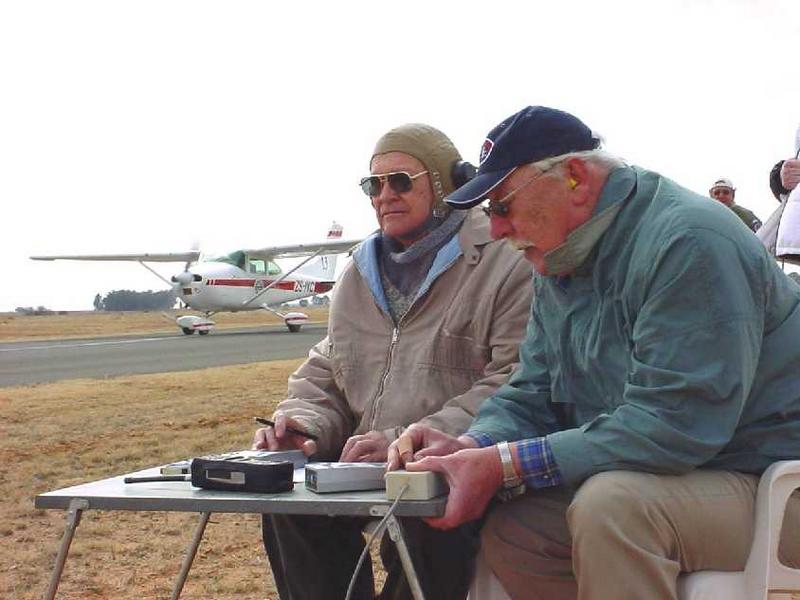


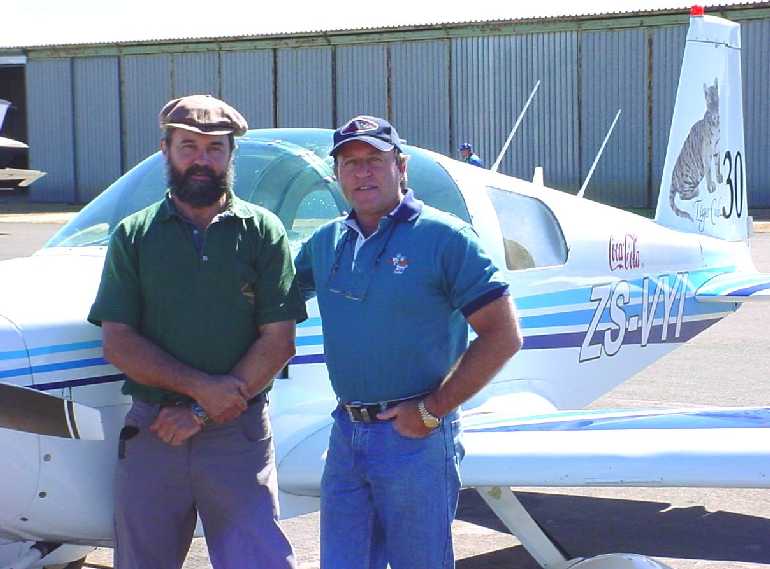

A report on the 2001 air race by winning navigator Dries Bries
When I was asked to write an article about the 2001 race, my memories took me back to the moment we arrived at Tempe the day before the race. I was very proud to arrive at the race for the first time in a Baron 58 as all my previous races were flown with a Piper Cherokee 235. I must say that at that point it did not worry me at all that it was my first race as a navigator, and that in a faster aircraft. That was soon to change.
I have always marvelled at the three different stages of the race. First there is the pre-race stage where all the strategy planning, nav calculations and handicap arguing is done. There are many decisions to be made, must we polish the aircraft or not, must we stay low or climb on each leg, must we go over or around that big mountain (I do not know how the organizers of the race do it, but they always succeed in getting some big mountain right in everybody’s way) and then there is always the furious matter of the handicaps. Very rarely will you find a competitor that is satisfied with his own and all the other handicaps. It is a matter of principle to some competitors to try and negotiate a better position in the race and some will still argue about their handicap even if they know thy can probably taxi faster that the given handicap. If by some unexplainable stroke of luck they do get a very good handicap in their own eyes, they could always pick a handicap of another competitor and argue that it is too slow. All of this is really harmless and only contributes to the overall race atmosphere as long as the handicapping committees do not take any offense. (All hats off to them, I would not take their job dead or alive) As far as the polishing of the aircraft goes, I arguing with my experienced captain about the use of this exercise, backing my argument with an article I once read on the topic. Chris overruled me with a comment that even if it did no contribute anything to the speed of the Baron, it will make it look better, so out come the polish, cloths and sweat.
On the morning of the first race day, the weather did not look very race friendly and we were not sure when the race will start. We were now about to enter the second stage of the event, the race itself. As I was not the pilot of our Baron and I knew that I was flying with the best pilot I have ever known, I was very relaxed and calm in contrast with everybody around me. How hard could it anyway be to navigate in the race, and I have after all been here before. When we eventually got the signal to start and line-up taxied past our most capable ground crew and I waved at them in a manner that could only bestow a true champion like myself. The next moment my heart nearly stopped when I realized that relaxed fool that I was, I left half of my navigational stuff including my stopwatches in the car. I went from total relaxed to total panic in less than two seconds. I could see that Chris was not impressed at all and the only thing that kept him from kicking me out of the aircraft at that moment was the fact that we were already on the starting line. I was still trying to figure out how to use our wristwatches when the flag dropped on us and the Baron jumped out of the starting blocks like a true thoroughbred. As I was watching the rapidly growing tree line at the end of the runway, I was waiting for us to get airborne and get enough height to clear those trees when I heard the gear cycle and realized we were already flying. I knew we could not flying through those trees and it sure did not look like we were going to make it over them so I started to get myself in the “crash” position. I also knew that I could not afford to loose any more face with Chris after the stopwatch episode, so I bend down and pretend that I was looking for a “pencil” that I have dropped. After a couple of seconds that felt like hours, I looked up and was surprised to see that we did clear those trees and I knew then that I was going to age a lot over the next two days.
When I just about sure that we were in our heading out of Bloemfontein, I saw that the only other aircraft in front of us was definitely not going in the same direction which created immediate panic and uncertainty. The temptation to follow them was very inviting but we decided to stay on our heading when I convinced Chris that I knew exactly where we were. When we arrived at the first checkpoint just in front of them we were both very relieved. The weather was not improving and as we cleared the mountains into Barkley-East, we were flying through light snow with bad visibility and severe turbulence. We were a bit confused when we turned over the checkpoint with no marshal on the spot. (The marshals manning that checkpoint told us that evening that they were delayed driving through bad weather over the mountains and saw us turn over the checkpoint in front of them just as they arrived in Barkley-East). The next leg to Bethuli was marked with heavy turbulence and radio confusion as the aircraft behind us entered the bad weather. Both Chris and I had the scare of our lives when the emergency hatch popped open as a result of the turbulence. The brave navigator was not able to close the hatch before some sun shields and charts were sucked out. He did all of this while his head was relentlessly pounded against the roof of the aircraft and with no regard to his personal safety. In the meantime there was confusion over the radio as some pilots gave constant weather updates at their immediate positions, others wanted to stop the race and turn back but were reminded that they did not have the authority to stop the race but they could only decide for themselves when conditions were not safe. A lot of teams did make the decision to return to Tempe and I think it will always be wise to live another day and to fly again rather than to continue into a situation where you feel it is not safe anymore.
Due to rain the visibility at Bethuli was very bad but we were both relieved when the view of Tempe filled our windscreen. Long before the last aircraft were back on the ground, the third stage of the race started. That is when everybody gathered with the necessary refreshments and shares their experiences with anybody and everybody who wants to listen. All about what they did do and what they should not have done, about making the right and wrong decisions and all the private races inside the main race. To me this is what the event is all about, sharing a passion for flying with people that feel the same way about it. This time however, there were mixed feelings about the race, as a lot of teams did not complete the race. The organizers were faced with a very difficult decision but at the end of the day decided that because there were more aircraft that did complete the race, they could not disregard the first day’s race. As a competitor would normally be disqualified from the race when missing a checkpoint, it was decided not to do that but to give a time penalty for each checkpoint missed and allow all the aircraft to keep on racing on day two.
As my time keeping with the wrist watches were not as good as I hoped for, we did not know how well we have done and therefore we were overwhelmed to hear the following morning that we were leading the race. It also came, as a bit of a surprise to hear that our brother-in-law and uncle were right behind us in second place. There was just no way that we could let them beat us. Although the weather was good I was definitely not relaxed. At this time I would like to remind you that I was use to racing at a hair-raising speed of 138 knots is the Cherokee, not screaming six foot over the ground at 200 knots. There is just something that feels not right when you fly at that speed and you look upwards at the birds in the trees when you pass them. The biggest difference between day one and two, apart from the weather, was that we were passing other aircraft on every leg. That was very nice as it confirmed every time that we were still on track and that we bettered out position every time we do so. The second day’s race proceeded without any major incident although I felt more like a passenger on the legs that was flown on the deck than like a navigator. It is just impossible to navigate properly when you are flying so low and I am sure that we had a lot of luck on our side. On the final leg to the finish line at Tempe, the adrenaline was pumping and Chris was not holding anything back. More than once I thought we were overtaken by another aircraft only to discover it was our own shadow. Needless to say that at such times I was tempted to start looking for that “pencil” again. When we heard Arel van Rensburg and Andre Koen calling two minutes out of Tempe, I told Chris that we were in fact also two minutes out and because we could not see them, we knew they had to be in front of us. Just as we got Tempe in sight, we saw an aircraft turning overhead, and we both knew that we were beaten. As we watched that aircraft we saw that it was flying in the wrong direction, and only then did we realize that was not the winning aircraft but the last of the contenders turning over Tempe as the halfway checkpoint. This race was not over yet and Chris pushed the Baron even lower to squeeze out any possible gain in speed. When we dashed over the last trees and over the finish line, I looked into the spectators eyes and I will never forget the looks of surprise and disbelief. We did not know that we have won until Arel called overhead Tempe. The rest is now history and will live in our memories forever.
After reading this, I bet you must wonder whether you will see me at Tempe again next year, but I would not miss it for the world. That is to say if the organizers don’t replace me with a GPS for the next event, which would be very sad as it would take all the fun and companionship out of the race, and you might be left to read a GPS printout when we look back on this years race.
Aero Africa report
Main event sponsors Coca¬Cola and Imperial Aviation, along with WCT, Ferreira Aviation, ATNS and Capital Sounds again made this popular event possible. This year’s race, hosted by the Bloemfontein Flying Club, under the auspices of the Aero Club of South Africa, drew 41 competitors, a marked decline ascribed by organisers to the worsening economic conditions and increased operating costs, as well as perceived dissatisfaction with the handicapping system.

The aircraft were flown under test at maximum power in a rectangular course with two legs cross-wind and one into¬wind and one down-wind. The unit then logs flight parameters every second of the flight. After the flight the data is then transferred to a computer and verified with respect of track and altitude holding. The result is then fed into a spreadsheet calculating the two average speeds. One for the into-wind and down-wind legs, and one for the two crosswind legs. The into-wind and down-wind average is then used for the Handicap speed. Of the 12 aircraft tested, not one’s speed could be proved wrong. For example, one was tested at 161.07 Kts and achieved 162.08 Kts on day two. Another was tested 109.30 Kts and achieved 108.09 Kts on day two. Hopefully this will once again restore confidence in the handicapping system and result in a much larger field of contestants.
The race covered a total distance of 654.45nm over the two day period. The first day’s route took competitors from Tempe – Reddersburg – Zastron – Barkley East – Bethulie – Tempe. The fastest aircraft took off at 10h00 with the rest of the competitors following at 30-second intervals.
Worsening weather conditions with severe turbulence, driving rain and even sleet were experienced near Barkley East, Bethulie and Zastron, resulting in a number of competitors missing their checkpoints, or simply turning back to Tempe. Some pilots even reported having struck their heads against the roof of the aircraft due to the severity of the turbulence. Two competitors made precautionary landings on a private airstrip in the Rouxville district before returning to Tempe later in the day. At the end of the day only 27 aircraft completed the course by getting timed at all the points along the race route.
This left the organizers with a unique problem, should the normal rules be applied to the already small field of contestants. The jury had quite a long session with the handicapping/scoring committee and a penalty system (minutes per turn point missed) was introduced to keep everyone in the race. Extra time penalties were added to those aircraft that returned to Tempe without trying to move on to the next turning point.
The second day dawned with clear skies, but any icy cold wind made every one reach for their thickest jackets. The route was Tempe – Smithfield – Trompsburg – Tempe – Harmony – Bultfontein – Tempe. This time the slowest aircraft started just after 10h00 with the fastest starting last.
The race was finally won by Chris Briers and his brother Dries flying a 1973 Beechcraft Baron 58, ZS-CHL, who crossed the finishing line just after 13h00 at an incredible 198 knots! For Chris this was a personal triumph, as this is the 14th time he has entered the air race, having never previously attained any significant placings. Second were Errol van Rensburg and Andre Koen in their Cessna 182P ZS-PWC, while third place went to Harry Antel and Barry de Groot in their Grumman American AA-1A, ZS-VYI.
With several aircraft converging on the finishing line at once, it made for a very exciting finish.
In order to increase the number of competitors in the 2002 Presidents Trophy Air Race, race sponsors Imperial Aviation have offered to give everyone who brings another entry next year, R200 back on their entry fees.