1999 President’s Trophy Air Race

Vanderbijlpark – 6 to 8 August 1999

Trophies

Trophy Name Awarded to Race A/c Reg Pilot/Navigator
Aircraft
President’s Trophy The Competitor gaining most time on Handicap 36 ZS-KHX Robert L Myburgh/Robert C Myburgh
Piper PA34-200T
Air Charter Trophy The Second Pilot Home 8 ZU-JAB Barry de Groot/Alex Clegg
Jabiru
Vincent Maclean Trophy The Third Pilot Home 77 ZS-MKW Christo Botha/Willem de Klerk
Cessna T303
Natal Mercury Trophy The First Kwa Zulu Natal Pilot Home 8 ZU-JAB Barry de Groot/Alex Clegg
Jabiru
Hoofstad Pers Trophy The First Transvaal Pilot Home 36 ZS-KHX Robert L Myburgh/Robert C Myburgh
Piper PA34-200T
Stellalander Trophy The First Cape Pilot Home 19 ZS-LJG Johan Dorfling/Flip van der Merwe
Cessna C170B
Phoenix Volkswagen Trophy The First Free State Pilot Home 82 ZS-NBB Kobus van der Colff/Walter Walle
Cessna C177RG
Northern Review Trophy The First Northern Transvaal Pilot Home 77 ZS-MKW Christo Botha/Willem de Klerk
Cessna T303
Gatsby Trophy Best Handicap Performance on First Day 8 ZU-JAB Barry de Groot/Alex Clegg
Jabiru
Wakefield Trophy The First Woman Pilot Home 88 ZS-FWX Marilette Kotzee/Arno Kotzee
Piper PA32-300C
Kassie Kasselman Trophy The First Father and Son Combination Home 36 ZS-KHX Robert L Myburgh/Robert C Myburgh
Piper PA34-200T
John Sayers Trophy The Crew of The First Turbocharged Aircraft Home 36 ZS-KHX Robert L Myburgh/Robert C Myburgh
Piper PA34-200T
Bloemfontein Flying Club Trophy The First Team with less than 1000 Hours 80 ZS-JUH Derek Edmund Brown/Bart Keiwiet
Piper PA34-200T
Dolf Kruger Trophy The First Homebuilt Aircraft Home 78 ZU-APZ Dieter Bock/Renier Moolman
Lancair 320
Beechcraft Trophy The Pilot of the First Beechcraft Home 6 ZS-HME Roland Pottie/Wyndham Ferreira
Beech C33A
Comair Trophy The Pilot of the First Cessna Home 77 ZS-MKW Christo Botha/Willem de Klerk
Cessna T303
Southern Africa Mooney Trophy The Pilot of the First Mooney Home 37 ZS-LGU Houkie Mostert/N Laubscher
Mooney M20J (201)
Placo Trophy The Pilot of the First Piper Home 36 ZS-KHX Robert L Myburgh/Robert C Myburgh
Piper PA34-200T
Westline Aviation Trophy The Winner of the Small Aircraft Category 9 N3050S Joan Kleynhans/Quintin Taylor
Cessna 150G
Natal Advertiser Trophy The Competitor covering the course in the Fastest Time 70 ZS-NJD Chris Briers/Ferdie Kahts
Smiths Aerost 600
Professional Aviation Trophy The First Helicopter Home 7 ZS-HSR Luigi Stravino/H Healy
Bell 206 III
Chris Swart Krugersdorp Trophy The First Krugersdorp Pilot Home 53 ZU-APZ Dieter Bock/Renier Moolman
Lancair 320
J L P C Trophy The First Johannesburg Light Plane Club Pilot Home 46 ZS-NXE Dana Bensch/Jeanette Bensch
Piper PA28RT201T
Carletonville Trophy The Pilot of the First Baron Home 41 ZS-PTC Johan Wasserman/Buz Bezuidenhout
Beech E55

Hamilton Airport, New Zealand – 20 to 27 February 1999

Extracted from an article by Phillip Treweek

The holding of the World Precision Flying Championships in New Zealand was quite a coup for the organisers. This was only the third time the competitions have been held in the southern hemisphere.

The competition was based in Hamilton. This is the traditional venue for the New Zealand national competition. The central location allows access to a variety of terrain for the navigation work, and Hamilton International Airport has a suitable amount of grass for the landing competitions. From the point of view of a large international competition, Hamilton city, has the accommodation and resources to support a large competition.

Opening Ceremony 1999 World Precision Championships - Bill Ottey
FAI representative Bill Ottley is escorted to the dais during the Powhiri or welcome

For the 1999 championships, 81 competitors from 23 countries attended. In addition there were supporters, judges, jury members, and helpers numbering in the hundreds. Even 24 personnel from the New Zealand Army attended, to assist with communications. Most gathered in the days leading up to the official opening on February 20th. Some competitors arrived early to practice in the local conditions.

The official opening started with a march on. Each team was led by a ‘Marching Girl’ bearing a sign identifying the team. Precision marching of this kind is a very New Zealand sport, and is a women only competition, very different to the military style of marching. The teams gathered in the car park, and then marched out to the ramp in front of the Waikato Aero Club (which served as the base for the competition).

The next stage was the Powhiri. That’s the Maori term for a ‘welcome’. Although mainly friendly these days, its origins are in the time when visitors might not have come with amicable intent. The Powhiri starts with a Karanga or call, inviting the Manuhiri or visitors to come forward. The next step is the Wero, or challenge. Two Toa (warriors) step forward and lay a token on the ground in front of the approaching visitors. If the token is picked up, this indicates the manuhiri are friendly – if it is not, then the vistors intentions are seen to be hostile.

Bill Ottley, as the FAI representative was the most senior of the visitors and accepted the Wero. As well as FAI representative Bill Ottley, the speakers included representatives from the organisors, local government, and the New Zealand Governor General, Sir Michael Hardie Boyes.

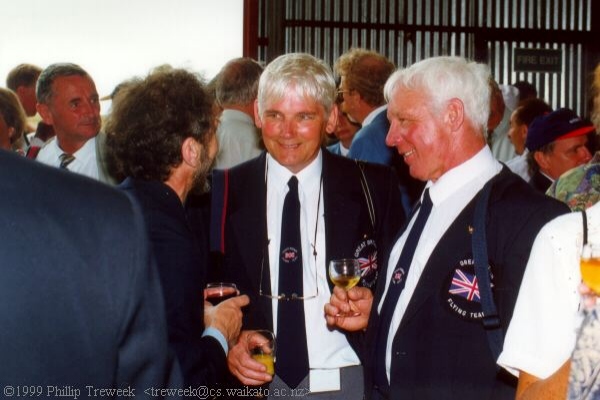
Opening Function 1999 World Precision Championships - John Fisher, Malcolm Evans and David Abraham
British team members John Fisher and Malcolm Evans talking to David Abraham, the sole Irish representative during the social hour of the opening ceremony.

The competitions consisted of several navigation tasks (and a practice day) and two landing days. The weather had some interesting effects. It was such a dry summer that the aerial photographs of some of the navigation targets had to be redone. The look of the targets had changed changed considerably as they dried out. The landing competitions also had to be moved as they disintegrated, and watering was required. Ironically, one outing late in the week (to Wharepapa South) was cancelled due to rain.

A good crowd of spectators gathered to watch the various attempts during the landing competition. It was interesting to note the different styles utilised by the different competitors. Some made a curving approach, some made a drop from on high, some came in low and keep the power on. The level of success varied too. Most competitors were on the grid, but one or two were short, and many went long.

Landings - 1999 World Precision Championships
Spectators on the crowd line. A good crowd turned out for the most watchable part of the competition.

The landing competition was in three sections. A standard landing, a flapless landing, and a barrier competition. The first two are fairly self explanatory. The third involved a 3m barrier being placed at the -50m mark. In practice this was a couple of poles with a string of flags which competitors flew over before making their landing. The barrier was dropped on several occassions when competitors got too low.

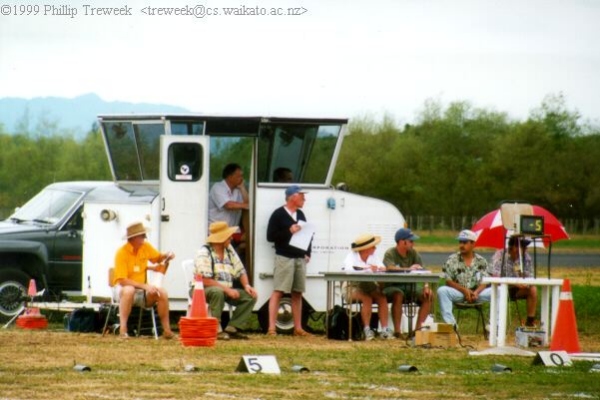
The most amazing part was being so close to the active aircraft. The grid was only 15 or 20m wide, and was lined with officials. A watcher sat on set divisions of the grid. Closer in, more observers made a measurement on each of the competitors who were closer to the mark. Several cameras recorded each attempt. And of course the judges sat and watched all the activity. A small portable control tower provided by the Airways Corporation kept track of movements, and was positioned next to the grid. It was really something to see the aircraft flying in and out amongst all these people. The aircraft came thick and fast. The tower recorded 81 competitors passed through the grid in 68 minutes during one section of the competition. Precision flying indeed. For a photographer it was quite stunning to have all these opportunities parade past my lens. It was different to see so many aircraft in the circuit.

Landings - 1999 World Precision Championships
The Airways Corporation provided a small portable tower. The officials are clearly watching the next approach. The grid markings can be seen in the foreground. The last competitors distance is shown on the display

The eventual outcome of the Championships saw Poland win (for the eighth time), with New Zealand in second place, and the Czech Republic third. A prize ceremony was held at Vilograd’s, a local restaurant set in a vineyard at Ngahinapouri.

Individual winners were Janusz Darocha of Poland followed by Daroish Krady of New Zealand and Jiri Jakes of the Czech Republic. In the Women’s competition Nathalie Strube of France was the winner, followed by Dee Bond-Wakelin of New Zealand and Ines Meier of Switzerland. Amongst the low houred (under 500) pilots, the competition winner was Greg Ward (New Zealand) followed by Hakon Fosso (Norway) and Johan Nyler (Sweden). The navigation competition went to Hungary (Laszio Bodis) with Poland in second (Michalski Ryszard) and third place (Janusz Darocha). The landing competition was taken out by Croatia (Zelimir Trifunovic) followed by New Zealand (Daroish Krady) and Slovenia (Robert Verbaci). The award for sportsmanship went to Sofia Svellossanova of Russia.

Full article and more picture on the website of Phillip Traweek – Kiwi Aircraft Images


Ron Stirk – Businessman

Ron started flying in 1988 and is a PPL (night and safety pilot ratings). He has served on the committee of the Brits Flying Club for a number of years as chairman.

He has represented his Province in rally and precision flying since 1991 and has been in the South African Team for 12 World Championships. Ron was crowned the World Landing Champion at the 2000 World Championships in Sweden and again in France in 2006. He has also served on the Board of the Aero Club of South Africa.

Committee member – 1999 to 2010