1988 State President’s Trophy Air Race image
1988-05-27


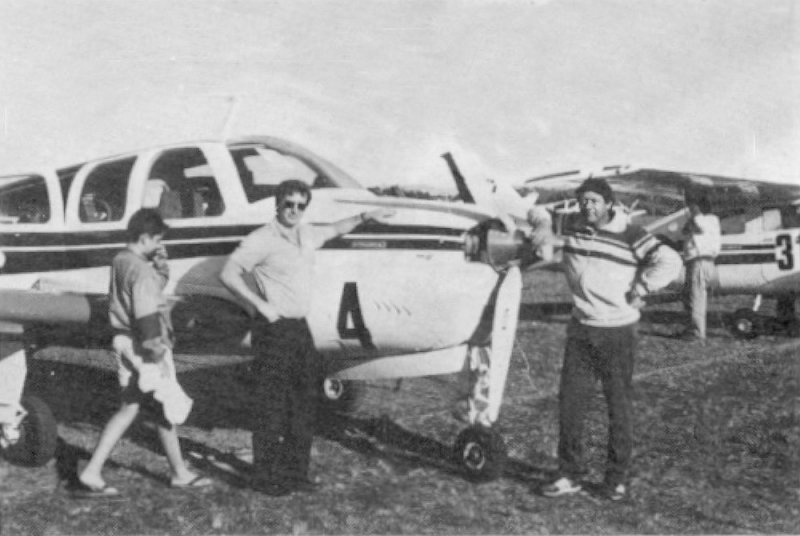



A series of three articles written by Vic Kaiser prior to the 1988 Air Race
Due to the high level of competition that has developed over the past years, I feel it is time to give the less experienced competitors some guidelines and techniques to improve their performance in this race.
First and foremost is NAVIGATION. The shortest distance between two points is the straight line that joins them (correct for the distances covered in this event). Unless you fly the track represented by that line on your map you will he covering a longer distance and hence reducing your chances of gaining time. Now if you are on your desired track you should also have no problem in locating the turning point early and position yourself such that you can be seen and positively identified. Penalties must be awarded if you are not identified at a turning point.
Another factor to consider under navigation is the TERRAIN you cover. Study your route carefully on the preceding day and calculate the change in elevation of the terrain enroute. Depending on the excess power. climb performance, of your aircraft, decide then when and where to climb. Rather climb early and plan for a “cruise climb” where you decrease your speed by say 10 knots whilst climbing at 200 – 300 fpm rather than flying right up to the high ground and then executing a steep climb at a much lower speed.
Associated with terrain are UP/DOWN DRAUGHTS as well as WIND. When flying in an updraught don’t try to maintain level flight but rather maintain your attitude and use the updraught to gain altitude which you can later trade for extra speed. Conversely, when encountering a downdraught fly down with the draught as far as possible changing your attitude gradually to avoid contact with the ground rather than an abrupt attitude change to maintain altitude. If however, you are very low, this obviously may not be possible.
While the above reasoning applies to crossing a ridge at say 90 degrees, when flying parallel to a ridge, you may choose to maintain a constant altitude and use the updraught to increase your speed.
Similarly expect updraughts on the windward side of the high ground and downdraughts on the leeward side and then apply the technique as discussed above. Bear in mind the manoeuvre limits of your aircraft when you encounter turbulence associated with the wind formations surrounding high ground.
Should the terrain be very flat and free from man-made obstructions and power lines AND you have the confidence and ability to do so you may elect to fly in “ground effect”. When flying in ground effect, the cushion of air below you generates additional lift. Now if you were to keep your height constant and hence your lift, you will find that your true airspeed will increase slightly whilst maintaining a constant height above the ground. Just remember to trim slightly nose up when applying this technique. This technique, however, is not recommended whilst flying over undulating terrain, as you will be in this year’s race.
However, ground effect is only effective up to a height of approximately 1/2 a wingspan. As you can see not only is it extremely difficult to fly at such a height, but additional problems with low level navigation are also encountered. (SAPFA note – this practice is actively discouraged as it increases risk significantly with an extremely low probability of a speed gain)
If you experience a tail wind cruise climb to gain altitude but remain in the tail wind as long as possible so as to maximise its effect.
Bear in mind however, if you climb too high you may he climbing “out of” a tailwind “into” a headwind segment and thereby cancel out any advantage given by the tailwind. Try to ascertain every few 100 feet whether you are gaining or losing in groundspeed before continuing. A good cue to look for lower down is to watch the ground features such as windmills, to determine the actual wind effect. The altitude gained, i.e. potential energy, can then be converted into a higher airspeed, kinetic energy. When approaching the turning point remembering that turn radius increases with an increase in speed. In order to minimise your radius of turn you will now have to increase your load factor, “g”. Know your aircraft’s structural limits as well as your own “g” capability and execute a minimum radius turn without “blacking-out” or high speed stalling whilst flying the track plotted on your map.
Also correlate the effect of a tail wind on your present leg to the next leg, as it may give you a headwind component on your next leg and thereby force you to alter your altitude. Similarly, when experiencing a headwind, change your altitude so as to minimise the negative component for the shortest time possible. Also ensure you are on track all the time whilst flying into a headwind, as any deviation will mean extra distance to be covered and hence a longer time spent in the headwind.
This article will be continued in next month’s issue and we will take a look at other factors, such as drag, weight, C of G, trim as well as various other flying techniques. By analysing each of these effects on your performance we hope to improve your chances of winning this race.
A series of three articles written by Vic Kaiser prior to the 1988 Air Race
In last month’s article we looked at Navigation, Terrain, Wind and Draughts associated with terrain. As promised we will look at a few more factors starting with DRAG.
We all know what drag is and how it affects our aircraft in general, but lets take a closer look at the various components of drag. We can divide TOTAL DRAG into two major components viz ZERO LIFT DRAG and LIFT DEPENDANT DRAG. Firstly lets analyse zero lift drag.
Zero lift drag can be further divided into 3 parts viz:
Surface friction drag, as the name implies, is dependant on the smoothness of your aircraft’s skin. If you polish your aircraft well and remove any unnecessary “dents” in the leading edges of your aircraft, you will minimise surface friction drag as the whole surface area of the aircraft has a boundary layer, and thus causes surface friction drag. Form drag is a factor that really only the manufacturer can minimise in the design of the aircraft. Likewise the interference drag which, for instance is found where the wings meet the fuselage etc. As a competitor in this event, you are not allowed to “fill” the rivets of the fairings in order to reduce interference drag, as that renders your aircraft as non-standard.
Next we look at LIFT DEPENDANT DRAG which we categorise into:
As you remember from basic principles there exists a positive pressure below the wing and a negative pressure above the wing. Now the difference in pressure between upper and lower surfaces causes air to spill around the wing tips and to form vortices. The effect of these is to produce a downflow past the wing additional to that resulting from the production of lift. This additional downflow causes additional drag and is known as induced drag.
The factors affecting induced drag are:
Consider weight. The higher your weight the more lift required, at a given speed to support this weight. If you require more, lift, you require a greater pressure differential between upper and lower surfaces and hence a stronger vortex resulting in higher induced drag. Keep your aircraft weight to a minimum whilst making sure it remains standard.
Lastly we look at SPEED. At a given weight. lift remains constant during level flight. Should you now increase the speed in our lift formula
L=Cl .5 P V2 S
we can see that in order to keep LIFT constant we must reduce our Cl (angle of attack). Now from the previous discussion, when we do this, we decrease the pressure differential between upper and lower surfaces thereby decreasing the vortex as well as the induced drag. After all the purpose of this race is to fly as fast as possible, and if you do this with your minimum permissible weight. you will minimise your induced drag.
Next we will look at C of G position. If we have an aft C of G we need a “lifting” force in level flight. In order to get an upward moment from the tailplane our elevator will be deflected downwards slightly, the mean camber of the whole tail section now being the same as that of the wings. The tail section now produces additional lift and if we look back at our lift formula, we can see that with all other factors contact, the V2, being TAS, must increase.
However, small and insignificant these factors may seem, remember that if you gain 1 knot at a handicap speed of 150 knots, you should gain 52,45 seconds over an average course distance. Now if you can improve your performance by say 3 knots. you gain over the whole race is already 5 minutes over your fellow competitor, in a similar aircraft who has not prepared his aircraft to fly only 3 KNOTS faster.
And finally consider your engine and your propeller. Your propeller is like a rotating wing and exhibits the same properties as an aerofoil. So if you file out all the “nicks” and polish both sides of your propeller, without removing the paint as such, you can reduce your propeller drag and at least gain 1 of the 3 KNOTS you are looking for. Set your mixture at the correct setting for your power setting and remember that provided you keep the engine parameters below the red line, you should not damage your engine in the race. The final do’s and don’ts will be continued in the next issue.