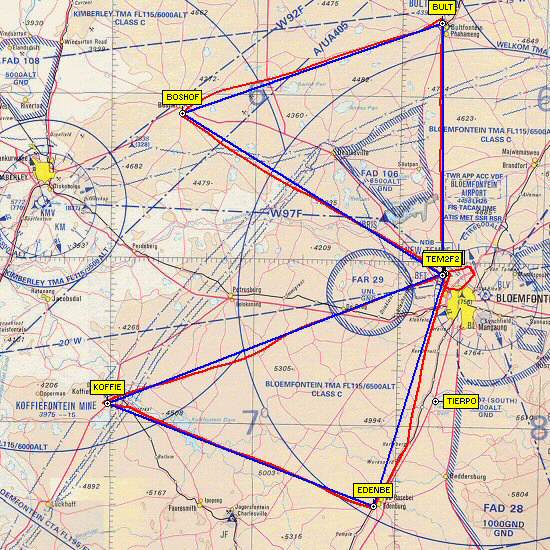
PTAR 2005 – Stayers Trophy

2005 Imperial Bank President’s Trophy Air Race
How to win the Stayers Trophy
Article by Viv
After much encouragement and persuasion from George Brink, which included the phrase, “it’s the most fun you can have with your headset on”, being said, (and posted on Avcom), many a time, Nasser and I decided to enter the President’s Trophy Air Race 2005.
Budget was in the lower end of the scale, so we decided on using a Jabiru SP. The plane was booked, and we were counting down the days.
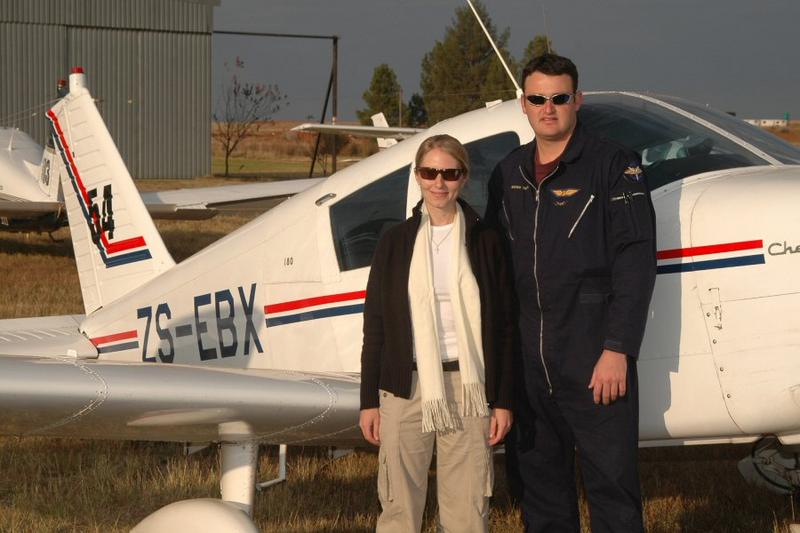
The Monday preceding the air race, we found out that our little aeroplane would not be ready in time, due to it having been for an engine overhaul, and still needing a few parts. People were phoned, pleas were posted on Avcom, and eventually we came across a flight school that was willing to hire out their Cherokee 180 to us…. Check rides were done, documents filled in, we were sorted.
Thursday morning arrived, and while preflighting, we realized that the rotating beacon was not working, and a replacement bulb wasn’t available. Not a huge dilemma, so we set off on our journey to New Tempe. En route, our intercom decided to cease functioning properly and didn’t allow communication to occur from pilot to co-pilot, obviously a problem in a race situation. No problem. We continued being confident that we would be able to sort something out once in Tempe.
At Tempe we organized the loan of another intercom (thanks George), got down to the business of attempting to clean the aircraft for the extra streamlining of our aircraft, and then attended the briefing which exposed the route of Day 1. Tempe – Tierpoort Dam – Barkley East – Springfontein – Tempe. Seemed easy enough. We plotted our navigation – the obvious lack of waypoints along one particular leg became apparent, namely the Tierpoort Dam – Barkley East leg.
Friday morning we took off at the prompt of the green light. First turning point was found easily, and then we turned onto our planned heading for the second leg. By this stage there were no other aeroplanes in sight. On turning onto the heading, it became apparent that the magnetic compass was not behaving as it should be, but was instead spinning non-stop. Not the end of the world, so we continued unperturbed.
The turbulence was unlike any I’ve ever experienced, (I now have countless bruises all over my body as the temporary evidence thereof), and after about 10 minutes into the second leg, a big bump caused me to lose hold of the stopwatch. After frantically searching for the stopwatch myself, Werner decided to give me control, unstrapped himself and jumped to the back to look for the stopwatch himself – that didn’t turn out to be such a productive move. The stopwatch was eventually located, although the digits on it no longer held any significance…..
We continued along on our merry way.

By this stage, we seemed to locate ourselves on the map, and things still made sense, but that didn’t continue for long. Soon, there were just too many hills and too many lakes, none of which appeared on the map.
While doing the nav planning, we had very unwisely cut away all irrelevant, (supposed to be), parts of the 1:250 000 maps we had, only to leave the planned route. (Big mistake if there are any big deviations in track, which proved to be our situation.)
Instead of panicking, we took the calm approach and just continued along, not really taking any decisive action, probably hoping, (and praying), that Barkley East would just somehow miraculously appear!
Just before two hours total time elapsed, Nasser casually said that we should look at a contingency plan: one that included finding out where we were. This is when Nasser decided to heed a friend’s advice as to what to do when lost (or temporarily unaware of your location). Fly low-level along a road and read the road signs. (Needless to say this friend is a chopper pilot!)
King Wiliiam’s Town 54 km
Bisho 69km
So it had seemed we may have gone just a bit too far south. Ok, not just a bit, more than twice as far as we were supposed to have! Luckily Nasser had done his PPL training down south, so he had situational awareness to his advantage, and decided to head to Bisho, where he knew there was a nice, big accommodating runway waiting just for us.
After landing at Bisho, we made our way to the ATC tower, where we got a bewildered welcome from two ATCs, playing cards. They had not even realised that we had arrived, (don’t worry, we did join and land procedurally!), and when we asked them whether they had some maps to help us plan our way back, they pointed to the large, faded map of Africa on the wall. That was not going to help us!
After making contact with a rather surprised fellow PTAR competitor, it was ascertained that with the headwind now being as strong as it was, there was no way we’d make it back to Tempe with the fuel we had left, and there was none available at Bisho. Not being too far away, Port Alfred seemed the next logical stop for us, as Nasser had friends there who were willing to assist us, and there was fuel aplenty. So off we went, (after paying our landing fees of course), experienced my first low-level flight at the coast and then landed on runway 25 at Port Alfred.
Once there our embarrassing story had to be told to many amused people, but we managed to get the maps we needed, as well as GPS as back-up since our navigating-by-map-skills had obviously much to be desired.
Off we traipsed to our aircraft, where we were greeted by a girl holding one of our wheel spats- in lots of small pieces. The consequence of what seemed to have been a very soft landing; how that happened still baffles us to this day….
So off we went back to New Tempe, by which stage the sun was already setting, which proved a good opportunity for Nasser to log some night-flying hours. After several attempts to contact Cape Town East Information were made to no avail, they eventually contacted us, and informed us that they had been made aware of our “situation”, even so, the ATC was incredibly helpful and friendly, and was very welcome in our time of distress. Nightfall arrived, and when switching on the cabin lights, we were dismayed, (but not entirely surprised), to find that they were not working. So using an alternative source of lighting, we continued our flight to New Tempe: Nasser controlling the plane, speaking to Information intermittently, and me, securing the “alternative source of lighting”, and controlling the cabin heat airflow. (It was freezing at FL095.)
We landed at Tempe at approximately seven o’clock that night, a considerable few hours later than most competitors, by which stage we were completely exhausted. The first day of PTAR had proven to be more eventful than we had expected a real comedy of errors!
We decided to participate in Day Two of the race, even though we had now been disqualified. It turned out to be thoroughly enjoyable, and I’m happy to report that we never came across any overtly large bodies of water, so there IS hope for us!
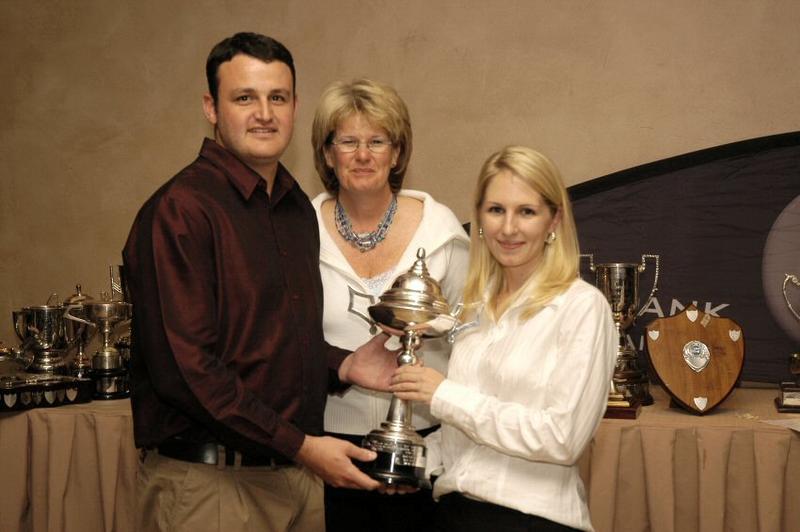
At the ceremony, we were awarded “THE STAYERS TROPHY”, and a lot of laughs were had on our behalf, but it was all in good fun, and we were commended on how well we handled our situation by many of the PTAR competitors, really wonderful people – just one of the many reasons participating in PTAR is such an awesome experience.
After an experience like ours, there are the “how’s” and “why didn’t you’s” asked by others and ourselves, and we admit that mistakes were made, but at least we enjoyed making them, and I think it’s safe to say that this has been a huge learning curve for us, as well as a memorable experience, which we will not forget very quickly. (If we do eventually forget, there will definitely be someone there to remind us!)
Look out PTAR 2006, here we come!