By Rob Jonkers, Photos by Cheryl Smit

The South African Power Flying Association held a very successful Speed Rally at the Aero Club Airweek 2019 at Middelburg. Originally scheduled as an Adventure Rally as was held in 2018, SAPFA decided to change this to a Speed Rally given the popularity of the event, with this one being the 4th in the series.

Within days of the announcement, the first 28 places were snapped up by competitors having taken part in the previous events, not leaving any room for new entrants and it was decided to extend the field from the original maximum of 30 to 35, with an opportunity for the local Middelburg club members to take part. This event is one that is flown at full speed under handicap conditions and the course is around 120 nm long, has 11 or so turning points, with each turning point identified with a correct photograph.

Planning got underway in February to prepare the route, keeping in mind that with the Airweek as an event and an Airshow to coordinate with, in terms of take-off and landing slots of other arrivals and departures made the details challenging to plan. The route was kept to the north and east of the airfield, as most inbound and outbound traffic would be from the west.

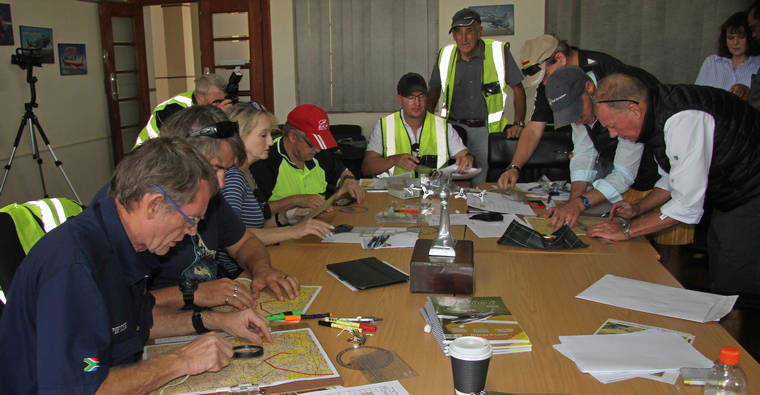
Friday saw a fairly full day of test flights with some repeat test flights to reconfirm handicaps, with conditions mostly favourable although the cloud base was low in the morning. After the Safety Aviator Presentations which started just after 2 pm, Mary de Klerk had arranged to hold a training session on how to fly a Speed Rally and which was very well attended, and included a practical map preparation session on an example map, sharing the tips and tricks of how to follow the map features and timing points.
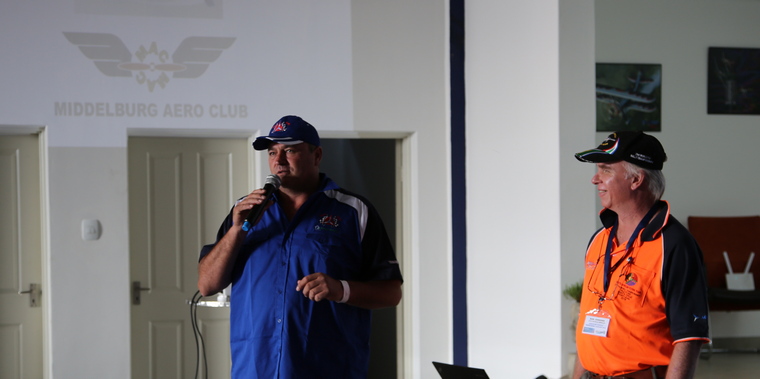
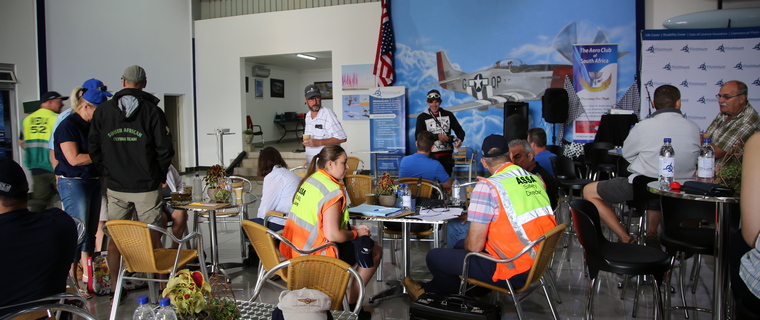


Thereafter at 6h30, Jonty Esser as the Race Master introduced Rob Jonkers who took to the stage and provided a briefing on what to expect for the next day in terms of the planned route, how many turnpoints, distance, departure and arrivals protocol and also how the scoring system would world work with expected weather conditions, which looked as if it would be good.
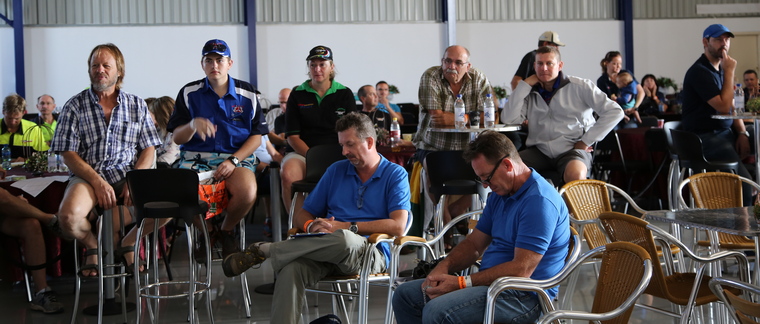


Then all the competitors were treated to a briefing on Steroids on Friday night with the Speed Rally Race Master Jonty Esser having set up a show for the teams with a real life lights, camera, action sequence where each team were introduced with their team theme song and handed their race numbers. Jonty also introduced the teams to the Speed Rally website where a Speed Rally ranking system was created with team profiles and their leaderboard position. 

The evening ended with a braai hosted by the Middelburg Aero Club, before retiring for the night. Some were camping under the wing or in Neil Bowden’s tent area. Saturday morning saw low cloud and some fog although it started to lift and clear fairly soon, giving a go ahead to start the rally.

The briefing started at 8h30, which was a shortened version just to cover the basics of the route, radio procedures and weather. With the briefing over teams prepared their aircraft, with marshals assisting in parking sequence while the organisers got the papers ready. Each team would then receive an envelope with a map, turnpoint photos, a minute marker and a GPS logger to record their track. Aircraft were then also scrutineered with all portable electronic devices sealed up in bags and although no onboard systems were disabled, it relied on an honour code to not utilise onboard GPS as a Navigation aid. The course is was however designed in such a manner that GPS would be of minimal benefit.


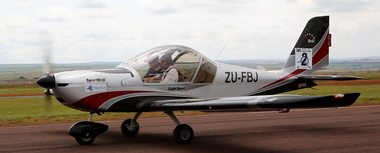
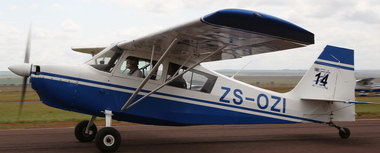
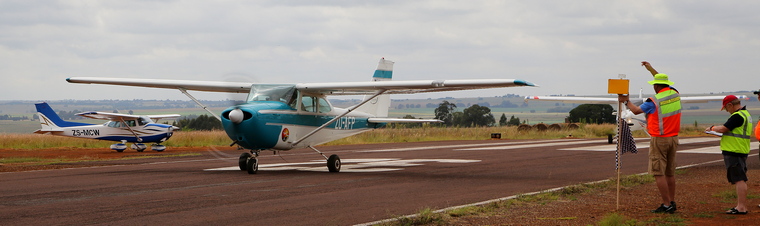
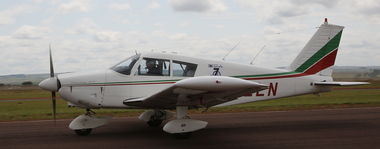
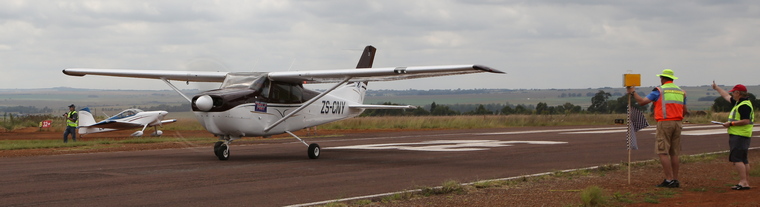
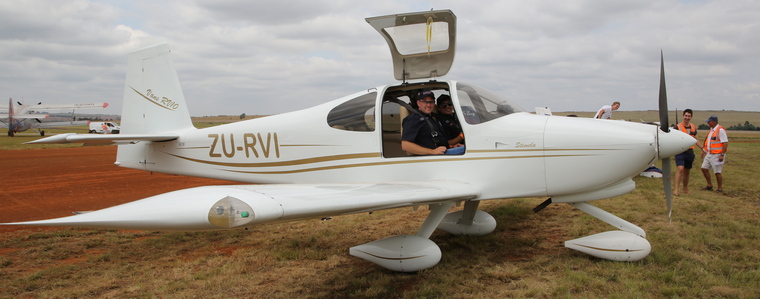
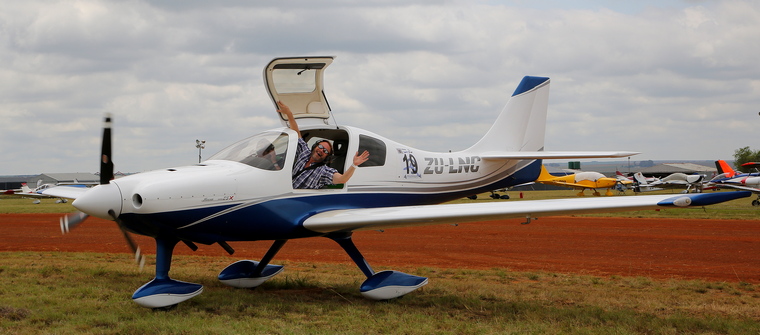
The Rally line up getting ready to start
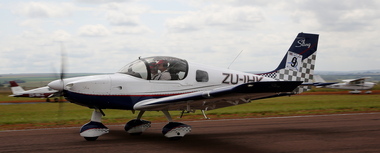


The intent is that everybody uses the basic skills of navigation plotting and flying and operate as a team in terms of cockpit workload, and with the course layout boasting short legs it for sure makes the crew resource work sharing all the more important. The idea would be that each crew would receive a pre-plotted map already complete with the route, turning points, headings and altitudes where the map would not have any lat/long or grid references. This would be provided 20 minutes prior take-off to allow route orientation and the plotting of minute markers.


In this format, there are two objectives:- fly against a pre-determined handicap speed for each aircraft fly the shortest route around the course which would consist of a minimum of 10 turning points. Any aircraft would be able to compete, from slower LSA aircraft to the fast turbo singles or twins. The idea would be to test the speed capability and navigation skills of each crew against each other, where the most accurate flying and turn performance management would win the rally. 


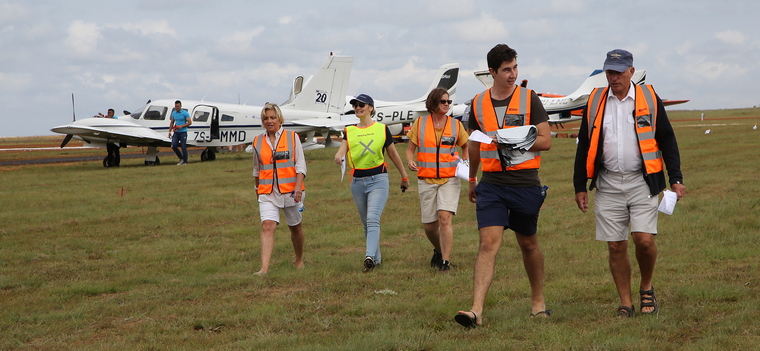
The scrutineers checking for illegal aids


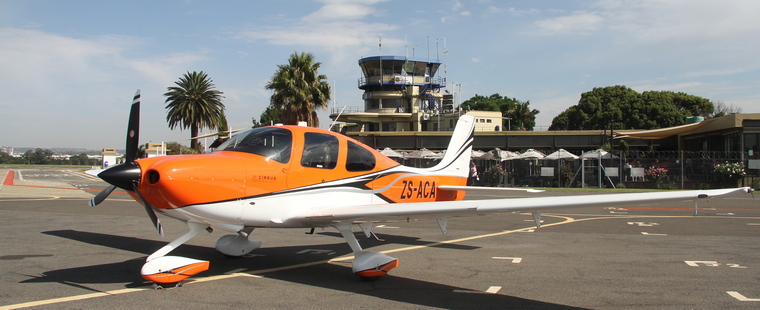
Scrutineers Chareen, Lizelle, Jean, Conrad, Frans and David were on hand to seal up all portable GPS capable devices, and also handing out papers at the allotted time time while simultaneously also checking that the fuel tanks were full. To assist the teams at getting their take-off roll accurate, a starting colour panel was used which was set up next to the start line on the runway by Chief Marshal Hans Potgieter and Mark Clulow, which would release them at their allotted time slot. Each team then received their envelopes with their loggers at their 20 minute prior to take-off time, and then taxi to the starting line within 10 minutes of take-off time. 1st take-off was at 09h55 for the slowest aircraft and last take-off at 10h50 with a planned arrival at 11h30. It was calculated that the fast Cirrus ZS-ACA would only need 40 minutes to complete the course.


With all the competitors off towards the north, the route had a mix of easy and challenging turnpoints to contend with to give competitors a chance to always be aware of where of their posistions. Some turnpoints were a challenge find, especially if the colour of the surrounding ground features had changed since the photos were taken. Although Turnpoint 2 was essentially along the road going past the airfield, it was still difficult to find apparently given how many were searching for it. Quite a few competitors cut the corners on turn points including Phil & Mary who during her training session warned everybody to “go round the TP”.



After all teams having returned and safe on the ground, the scoring team got to work to analyse the results, and with the new loggers, were able to complete the scores by 1 pm, after which everyone was given their score sheets. Prize giving would only be in the evening so the teams and officials could enjoy the Airshow for the afternoon.

With everybody settling in for the VIP dinner hosted by the Middelburg Aero Club and opening speeches and starters enjoyed by the guests, the prize giving was coordinated by Jonty Esser acting as the MC for this time slot. Firstly aircraft judging certificates handed out by EAA’s Sean Cronin and thereafter a showing of a number of interesting flight tracks given by Rob Jonkers which for this rally turned out overall to be very good, with only one competitor having had some navigation trouble and for sure the overall standard is improving, with all aircraft over the line within 7 minutes. As the teams were visible approaching the field, first in view was Jonty Esser in the slowest aircraft a Foxbat being chased down by Phil Wakeley in a C210, who crossed the line within 8 seconds of each other. Some other interesting facts were that the full field also completed the course with an average of 7 nm overflown and the best performance against handicap time was 25 seconds.

After this the Speed Rally promo video was shown after which prize giving commenced and which was hosted by Frans Smit from Pilot Insure who was this Speed Rally’s main sponsor. First a Hard Luck certificate was handed out to Jaco Goosen whose C182 fell into a subterranean aardvark tunnel and damaged the horizontal stabilizer after which Jonty handed over the Club Trophy to Richardt Lovett and the Middelburg team.
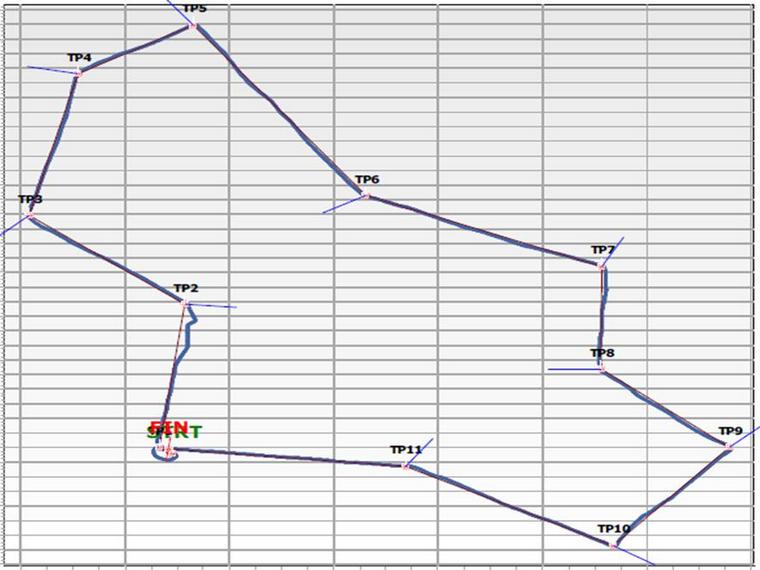


The winning track – ZU-DYE

Having a bad day, but not bad considering the good recovery – ZU-LAX


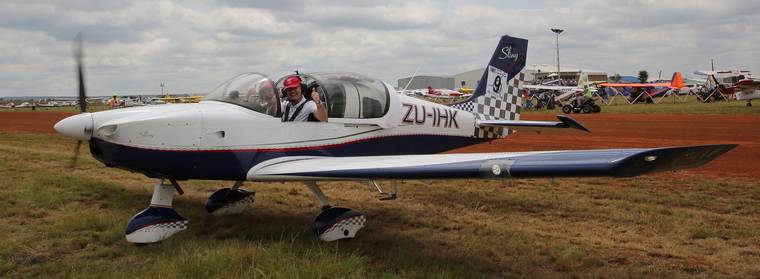
The overall winners in the best handicap speed were the team of Jonty Esser and Jonathan Esser in a Foxbat ZU-DYE. Second place was Arthur de Kock and Freddie van Rooyen in their Jabiru J430 ZU-MEL while Hendrik Loots and Jandre Loots bagged the final step of the podium in their Sling 2 ZU-IHK. The first fourteen placings were the only crews who managed a clean penalty free round.

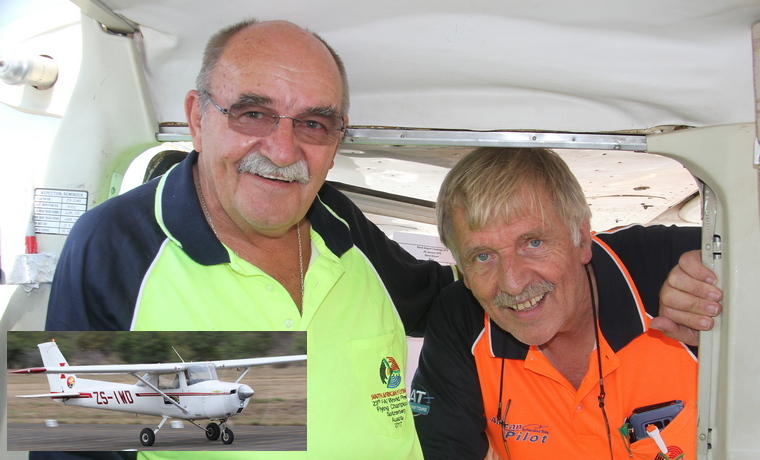
The winners in the accuracy category were the team of David Ross and James Braid in their Sling 2 ZU-JAR. Second place was Johan van Eeden and Cor Esterhuizen in their RV7 ZU-IHH, and in third place the skopgat team of Ron Stirk and Von Hamman in their C150 ZS-IWD.

Many thanks to the Middelburg Aero Club for hosting this fantastic event, the SAPFA team of Hans Potgieter with the ground marshals, Nigel Musgrave as the Safety Officer, Dirk and Louna de Vos and Mark Clulow doing the scoring with our handicapping guru Chester Chandler, Chareen Shillaw, Lizelle Kruger handing out competition papers to the crews and to Jonty & Lizelle for putting together an awesome Friday evening launch event. Also thanks to Mary de Klerk for the time made available to do the training course held on Friday- it sure helped the teams to gain an understanding of what to expect.


A big thanks to Pilot Insure who were the main sponsor of the event, Flightline Weekly for sponsoring the race numbers and also to Pilot’s Post for sponsoring the team of Phil Wakeley and Mary de Klerk. Pilot’s Post Willie Bodenstein provided three key reasons for why they entered into the sponsorship agreement. The first one being that the Speed Rally is being marketed as a brand and will be seen as the future of competitive flying. The second being that the Speed Rally brand will add value to their brand and thirdly that Pilot’s Post believe that Phil and Mary are the perfect ambassadors for their and they will carry their flag high.

The next speed rally is in Bethlehem on the 8th June 2019


By Rob Jonkers

As a follow-on to the Rally Navigation Training event held at Aerosud on the 19th of January 2019, it was planned to fly the practice route that was plotted on that day. The 16th February was chosen and as the week unfolded with almost daily rain, it looked doubtful to get good weather, although it looked a little promising on Friday. As the day dawned, the clouds were on the deck throughout Gauteng, north of the Magalies in the Brits area was a bit better. The cloud base only started lifting around 9 am, and then only in patches, so even with 12 teams registered to take part, only 4 teams eventually were able to get to Brits. Frank & Cally Eckard prepared the route packs for the teams and were on hand to do the scoring.


Frank Eckard – Presenting the Rally Flying Techniques Course.

The focus of the day was more related to flying techniques and Frank Eckard provided an hour’s presentation on how to prepare the cockpit, roles of the crew in work sharing, organizing the photos, flying techniques such as speed management, altitude and the approach to turn points.


Nigel Hopkins & Mary de Klerk preparing their maps for their flight.

The teams then plotted the course, basically replotted the course that was previously prepared a month ago and went to fly the route. Aerobatics ace & SAA Captain Nigel Hopkins who has been a previous rally world champion 15 years ago, flew with experienced navigator Mary de Klerk, and proved by his excellent score of 64 penalty points that he has not lost his touch in rally flying.


Leon Bouttell & Karyn Purchase preparing their plots.


Veteran Protea pilot Thys van der Merwe preparing the maps with navigator Frans Smit.

As SAPFA is preparing for the World Rally Flying Championships in 2020, the focus on the two years prior the event is to gain as many South African qualified teams to take part, and every event being held this year will be an event that can improve skills.


Nigel & Mary preparing the cockpit.

To achieve world standard qualification, there is a route to achieve these skills in classes, with Advanced Class as the definitive level of competition, where existing Protea teams would compete, and new teams would vie to achieve a qualification standard. The initial Sportsman’s Class is the entry level where teams gain experience to get to try their hand at the Advanced Class. There is also an Intermediate Class, which has a combination of Protea pilots and navigators that fly or navigate with new team members as further skill building in a step to achieve an Advanced level.

 
A competitive score for Nigel on a route with arcs and follows the feature.

As the weather was not favourable on this weekend, SAPFA will look at rescheduling this event again at a future date.

The next rally is being held at Virginia on the 26th March. For more information Contact Mary de Klerk cell: 084 880 9000 e-mail: maryd@expandingbranding.co.za 


The 15th Rand Airport Challenge 2019

By Cally Eckard. Photos by Willie Bodenstein


The SAPFA Committee, particularly Rob Jonkers and Mary de Klerk, who organised a very thorough workshop recently on Rally Flying, saw their efforts bear fruit at the annual Rand Airport Challenge, when a record 8 teams took part in the Intermediate form of the sport. In previous years most participants preferred to stick to the simplest and easiest form which is Fun Rally, but this year pilots and navigators were encouraged to enter the more difficult category. The reason for this is to elevate their skills levels, so that they can participate at national level, thereby building up a new breed of South African champion rally pilots and navigators.


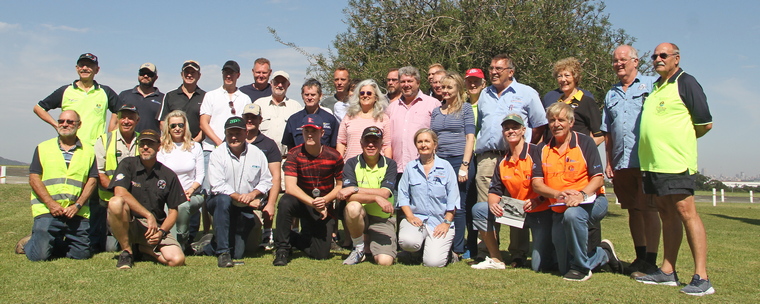
Participants and organisers at Saturday’s Rand Airport Challenge

The navigators and pilots in the Intermediate category had one hour to plot the entire route, and had to do so in the cockpit, which was a first for most of them. They also had far more photo targets to identify, and these were mixed up instead of being sequential and only one per leg. The pilots had only a 5 second window to get through each turn-point, instead of 15 seconds for Fun.


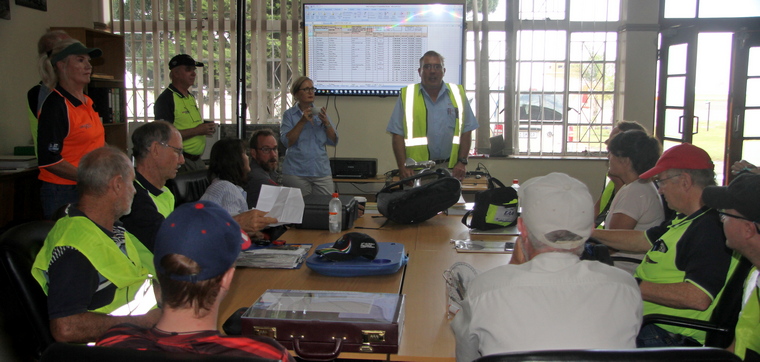
Frank during the briefing.


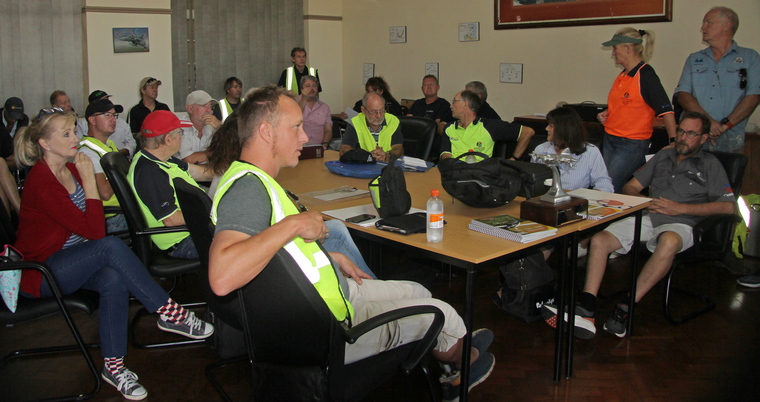
Some of the participants during the briefing.


Participants hard at work plotting their routes.


Organisers Frank and Cally Eckard gave them the task of flying an arc, which is a curved track between two turn-points, and a follow-the-feature, where they have to fly along a road, river or railway line. Every pilot flew the arc perfectly, and really enjoyed the challenge.


Jonty Esser and son Jonathan finished 2nd in the Intermediate Section.


Rob Jonkers Martin Meyer won the Unlimited Section.


Don Lucas and Andre Kluyts were placed 4th in the Intermediate Section.


Phil Wakely and Mary de Klerk did not complete the course due to mechanical problems.


Hans Schwebel and Ron Stirk were placed 2nd in the Unlimited Section.


Shane Britz and Karen Stroud were the winners of the Intermediate Section.


The route took them south from Rand Airport, around Suikerbosrand to Heidelberg, then down to two turn points on the banks of the Vaal Dam, and back again near Vereeniging to the Finish Point at Klipriviersberg Nature
Reserve.


Leon Bouttell and Karyn Purchase finished 5th in the Intermediate Section. 


Adrian Pilling and son Adam were placed 3rd in the Intermediate Section. 


Thys van der Merwe and Gerda Pienaar finished 2nd in the Fun Rally section. 


Kim Pratley and son Andrew finished 3rd in the Fun Rally section. 


Piet Meyer Pieter Kriel were placed 4th in the Fun Rally section. 


Mark Clulow and Renee Clulow were placed 6th in the Intermediate Section.


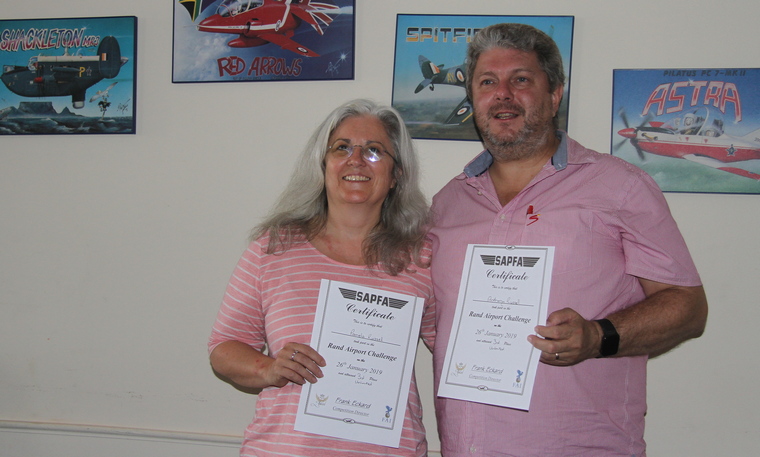
Antony and Pamela Russell who came all the way from Cape Town to compete finished in 3rd place in Unlimited Section.


RC and CJ Shillaw were the winners of the Fun Rally section.


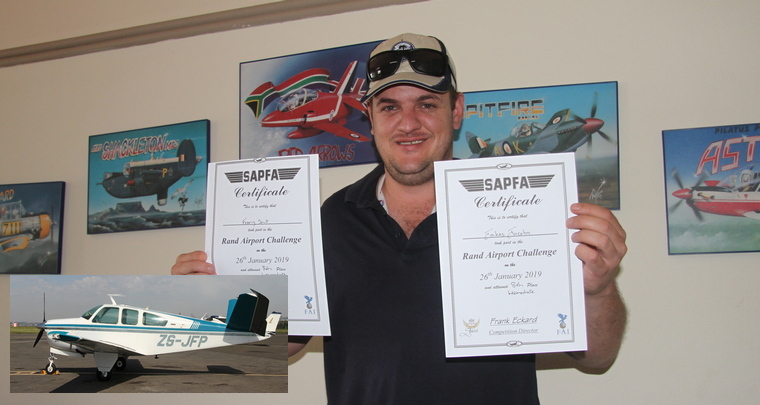
Jakes Jacobs and Franz Smit did not complete the course due to mechanical problems.


Shane Britz and Karen Stroud the winners of the Rand Challenge.
 

Rand Airport, who sponsors the Rand Airport Challenge Trophy, also waived landing fees on the days for the participants. The trophy was won by the defending team of Shane Brits and Karen Stroud, who have been putting a lot of effort into their sport.The full results are:

The Fun Rally section:

Pilot Navigator Points
1 RC Shillaw CJ Shillaw 319
2 Thys van der Merwe Gerda Pienaar 870
3 Kim Pratley Andrew Pratley 1231
4 Piet Meyer Pieter Kriel 1410

The Intermediate Section:

Pilot Navigator Points
1 Shane Britz Karen Stroud 750
2 Jonty Esser Jonathan Esser 967
3 Adrian Pilling Adam Pilling 982
4 Don Lucas Andre Kluyts 1488
5 Leon Bouttell Karyn Purchase 1955
6 Mark Clulow Renee Clulow 2170

Unfortunately the two teams consisting of Phil Wakely and Mary de Klerk, and Jakes Jacobs and Franz Smit did not complete the course due to mechanical problems.

The Unlimited Section:

PilotNavigatorPoints
1 Rob Jonkers Martin Meyer 409
2 Hans Schwebel Ron Stirk 766
3 Antony Russell Pamela Russell 1344

Everyone thoroughly enjoyed the challenge of this sport, and is all very motivated to take part in the next events:

· 1-2 Feb – Cape Speed Rally, Morning Star
· 16 Feb – Training Day in Brits, with the focus on the role of the pilot, and cockpit-management
· 23 March – Virginia Rally, Durban (with a training course on 22 March)
· 4 – 6 April – Rally Nationals, Stellenbosch
Please enter online at Sapfa.org.za