SAPFA Rally Training Camp – Aerosud Premises 19 January 2019

By Rob Jonkers

SAPFA held a very successful training event on Rally Navigation on Saturday 19th January as the first SAPFA event of the year. Initially planned for a maximum of 30 participants, and at Grand Central, the eventual total participation was 50, and fitting everybody into the Aerosud training hall proved a challenge.


Alan Evan Hanes – GM of the Aero Club with a short Aero Club Intro
It is great to see the sport being supported so enthusiastically, and the willingness to learn these basic skills of map reading and planning. The GM of the Aero Club Alan Evan Hanes opened the day with a brief overview of the Aero Club and its functions, that the Aero Club has as its mission to protect all forms of Recreational Aviation, and supports Sections of the Aero Club such as SAPFA to be able hold successful events within the procedures governing recreational aviation in SA.


The Participants – 50 in total
With that Mary de Klerk took charge and laid out the objectives of the day, by initially going through the theory of plotting, and then to practice on an actual plot. With this year of 2019 having a full calendar of events, and the Nationals coming up in April in Stellenbosch, and with SAPFA having won the bid to host the World Rally Flying Championships in 2020 (which is also the Centenary year of the Aero Club), this training event would serve as an excellent platform to entice new members to the sport and to start training for the Internationals and obtain Protea Colours.


The Rally Plotting Class of 2019
Mary first started off with having everybody introduce themselves, and what they each had as objectives for training, some were there as newbies interested in taking part in the sport, some having takien part previously indicated they needed some formal and expert training, and some others indicated they just wanted to delve more in depth than what a ppl course would give on the art of paper based navigation.


From there Mary outlined the theory on plotting procedures and described the tools of the trade. Then it was off to plotting an example course which had to be done from basic plotting principles of co-ordinates, bearings (which could be in either true or magnetic) and distances (either in nm of km). Each turning point then had to be found and identified and linked into legs, some of which could be arcs or follow map features.

The goal in getting to National level standard is to be able to plot in the aircraft with a papers time of around 30-40 minutes prior take-off, which means speed is of the essence in doing the plot, so that the navigator can assist with finding and identifying the ground photos.

The morning’s training ended off at around 11 am, and after a short break, everybody got their first route in an envelope, got the laminated transparent tool, which they had to cut out, and proceeded to plot each of the turn points making up the route. It was decided to proceed right through lunch, and most had finished their plot by after 2pm. The course was ended off with an in cockpit video of one of Rob & Martin’s 2012 rally flights to show how the leg photo features match up with the real world outside to give the perspective of what one sees outside the cockpit from the flying height and distance.

Everybody left with some knowledge gained on plotting and techniques of planning & flying a rally, and it is hoped that many will come to the Rand Challenge on the 26th January and Nationals in April.


Daniel Ralefeta and his team of Rise Above Aviators getting ready to plot


Feverously map reading and plotting
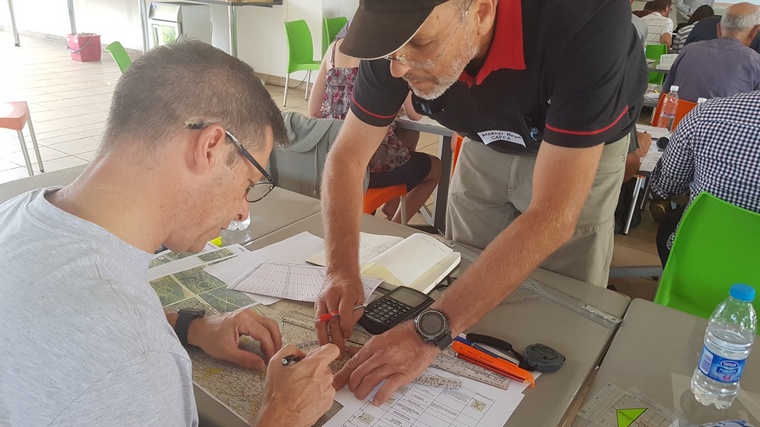

Martin Meyer assisting Dave Thomas

Mark and Rene Clulow figuring the plot.


Newbies to the sport, Time Scharf, Conrad van Coller and Daniel Ralefeta

Mary de Klerk assisting Melika Mohapi with Franz Smit & Ashley Loynes at left

Kim Pratley and his son Andrew Pratley working their plot

Protea pilot Adrian Pilling and newly minted ppl pilot son Adam learning from the expert


Arthur Piercy working his plot

Michael Stofberg & Bryony Martin from 104 squadron


Virtual Aviators Johan van Wyk and Freek Stegman


Shaun Barron with Cally Eckard helping in the background

Rob Jonkers explaining some flying techniques


Springs Speed Navigation Rally – 24 Nov 2018  by Rob Jonkers (photos by Willie Bodenstein & Rob Jonkers)

The South African Power Flying Association (SAPFA) together with the Springs Flying Club organised the second successful Speed Navigation Fun Rally on Saturday 24th November 2018.

 Springs_0

 The competitors after the Saturday morning briefing

Although originally planned as a fun rally, after the success of the Secunda Speed Rally held in October, it was decided to hold the Speed Rally format again for Springs. With the entries limited to 30, the list quickly filled up after the website entries opened, and even with some scratchings due to aircraft availability, the waiting list grew to refill the 30 places. We for sure have something going as far as excitement on this type of event goes. The entries also included many family member teams, four father & son teams, 2 teams with brothers, and 2 teams with husband and wife combinations, a very varied field for sure. There were also five teams that entered from the Springs based Mach 1 flight school, these budding CPL crews had their first taste of real map reading skills being put to the test.

 Springs_1

Springs_3Springs_4

Jonty Esser and Rob Jonkers busy with the competitor briefing 

This event is one that is flown at full speed under handicap conditions, thecourse is around 120 nm long, has 11 or so turning points, with each turning point identified with a correct photograph. This is also an event where no GPS aids are allowed, thus for this event, all portable devices are sealed, although no aircraft units are deactivated, but discouraged in their use in an honesty system, although there would be little time available to attempt to program anything.

The intent is that everybody uses the basic skills of navigation plotting and flying, and operate as a team in terms of cockpit workload, and with the course layout with short legs it for sure makes the crew resource work sharing all the more important. The idea would be that each crew would receive a pre-plotted map already complete with the route, turning points, headings, altitudes, where the map would not have any lat/long or grid references. This would be provided 20 minutes prior take-off to allow route orientation and the plotting of minute markers.

In this format, there are two objectives, fly against a pre-determined handicap speed for each aircraft, and fly the shortest route around the course which would consist of a minimum of 10 turning points, and any aircraft would be able to compete, from slower LSA aircraft to the fast turbo singles or twins. The idea would be to test the speed capability and navigation skills of each crew against each other, where the most accurate flying and turn performance management would win the rally.

 Springs_5

The team of Jason Boshoff and Sarnia Hattingh in their RV6 ZU-BVC

Friday was set out as the day to carry out flight tests to establish handicap speeds, and the day started out with low cloud and plenty wind, which delayed the start to the test flying, but eventually at midday or so the weather had improved sufficiently, although not ideal, making the test flight results problematic, especially with turbulence affecting achieving stability of speed in each leg. In any event between the test flight results and other event handicap history were able to obtain a starting grid.

 Springs_6

The line-up of aircraft prior start-up 

All the competitors were treated to a briefing on Steroids on Friday night with the Speed Rally organizer Jonty Esser having set up a show for the teams, with a real life lights, camera, action sequence, where each team were introduced with their team theme song, handed their race numbers. Jonty also introduced the teams to the Speed Rally website where a Speed Rally ranking system was created, with team profiles and their leaderboard position. After this excitement, it was the turn of Rob Jonkers the event planner to bring everybody down into serious mode and provided a briefing on the event and some training on how to fly the rally with some basic tools. After this some excellent live entertainment was provided and a braai/buffet dinner.

 Springs_7

The father and son team of Piet and Willie Meyer busy plotting on the tail of their Jabiru ZU- DUU

See Insert story of Piet and Willie’s Flight Below

Saturday morning dawned with the wind pumping in from the north but predicted to reduce during the day, and after the host club providing a great breakfast, the briefing got underway just after 8h30, and prior to that ground marshalls were pointing out parking places, and refueling slots.

 Springs_8

The team of Daniel Igun and Nkosi Fanti busy plotting in their Cherokee ZS-MKZ 

The briefing was shorter than the previous evening, and focused on the procedures for scrutineering, the handing out of papers, starting line, and finish protocol. The aircraft were parked in order of slowest to fastest, with a 15-30 second gap as a minimum between them, with the idea to have all the aircraft cross the finish line as close to 12 noon as possible, given that everybody needs to achieve a perfect route around the course.

 Springs_9

The team of Ala Buserwil and Tintso Mabunda with their C172 ZS-PED

Scrutineers Chareen, Kevin, Karyn & Sandy were on hand to seal up all portable GPS capable devices, and also handing out papers at the allotted time. To assist the teams at getting their take-off roll accurate, a starting colour panel was used (simple triangular three colour board – which was much improved over the daylight non visible light system used previously), which was set up next to the start line on the runway,  which would release them at their allotted time slot. Each team then received their envelopes with their loggers at their 20 minutes prior take-off time, and the teams taxied to the starting line. 1st take-off was at 10h25 for the slowest aircraft and last take-off at 11h20, with planned arrival at 12h00, the fast RV10 ZU-DSE only needing 40 minutes to complete the course.

Springs_10

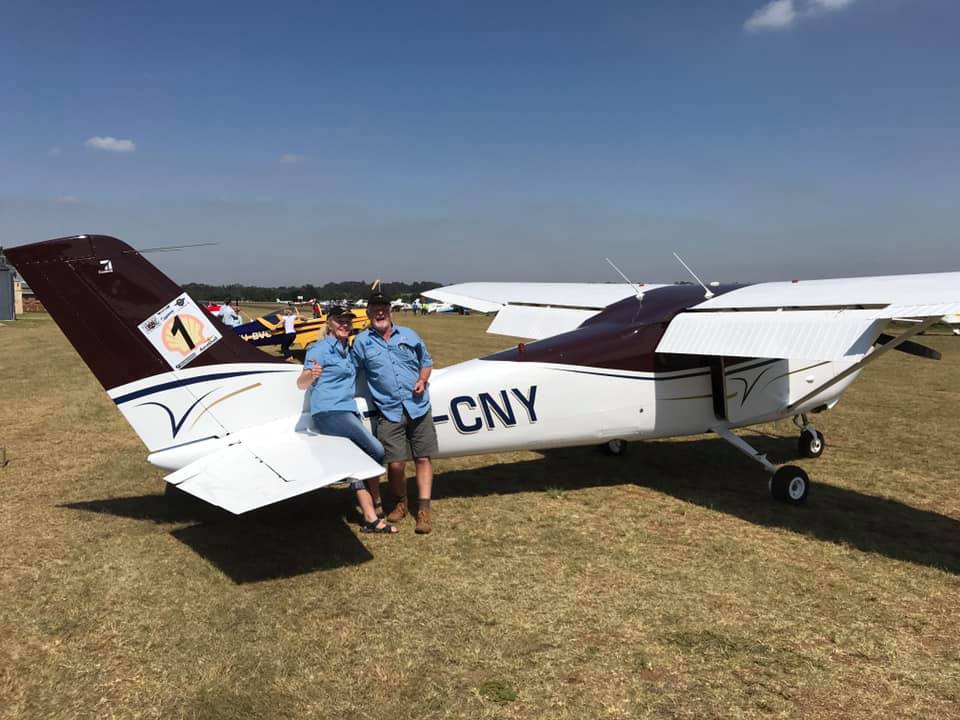
Mary de Klerk and Phil Wakeley getting ready in their C210 ZS-CNY 

With all the teams airborne and finding their way around, the first teams were back on schedule and were streaming in one after the other, some having overtaken others either having flown a good navigation route or having flown close to their handicap speed. For this event, with the wind and turbulence the lighter aircraft would have had a harder time to achieve their handicap speeds compared with the heavier high end aircraft which are less affected, but the wind started to die down from around 11 am onwards but the turbulence remained a factor.

Springs_11

The team of Bob Cohoe and Gerda Pienaar in their Stinson ZU-OZI

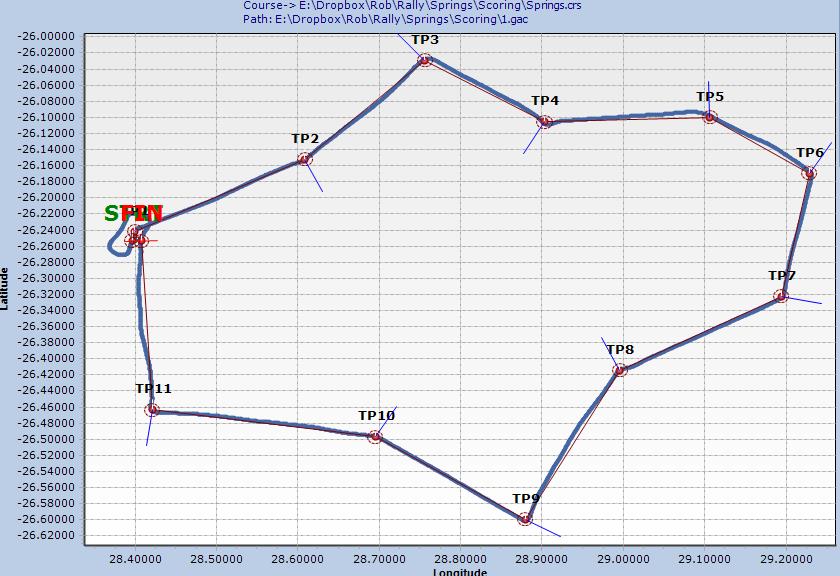
After all teams having returned and safe on the ground, the scoring team got to work to analyse the results, with the  tracks for many being quite accurate, although some had wobbles, only two teams got lost and had to switch their GPS on and press the Direct-to button to get back to Springs.

Springs_12

 The take-offs of equally handicapped C210’s

The results were completed by around 14h45, and prize giving could start at 3 pm, and first up on the prize giving programme was to show some of the interesting tracks, some excellent and some not so good getting the audience in fits of laughter. Jonty first handed over the host club floating trophy to Eric Addison representing the East Rand Flying Club, and then the placings for the best handicap speed and thereafter the most accurate / shortest route flown.

Springs_13

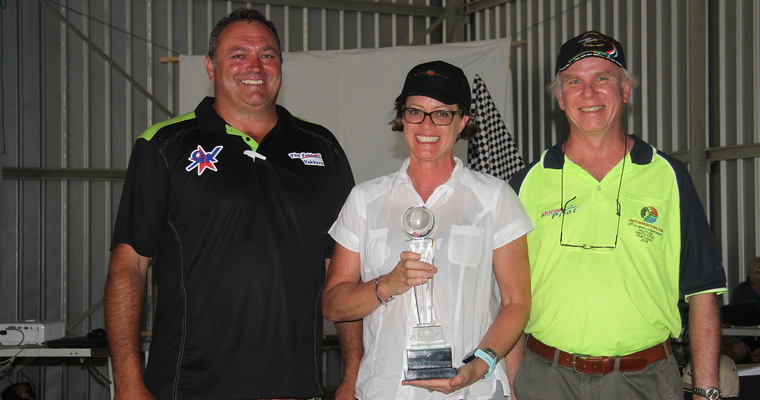
Winners of the best speed and shortest distance flown – Phil Wakeley and Mary de Klerk in C210 ZS-CNY

The overall winners in the best handicap speed were the team of Phil Wakeley and Mary de Klerk in a C210, in second place was Ryan & Chris Shillaw in their Cirrus SR22 ZS-ACA, and in third place Johan van Eeden and Gavin Edwards in their RV7A ZU-IHH.

Springs_14

2nd placed Ryan & Chris Shillaw in their Cirrus ZS-ACA with Chareen Shillaw receiving the trophy

 Springs_15

3rd placed Johan van Eeden and Gavin Edwards in their RV7 ZU-IHH 

The most accurate / shortest route flown winners were the team of Mauritz du Plessis and Andre Kluyts in the C172 ZS-SYA, in second place was Wim Kotze and Rob Gobac in their Yak 52 ZU-AMC, and in third place was Leon Bouttell and Martin Meyer in their Sportstar ZU-FBJ.

 Springs_16

 1st  placed Mauritz du Plessis and Andre Kluyts for the most accurate route flown

Many thanks to the East Rand Flying Club for hosting this fantastic event, the SAPFA team of Hans Potgieter as the Competition Director, Nigel Musgrave as the Safety Officer, Dirk de Vos and his wife doing the scoring, Chareen Shillaw handing out competition papers to the crews, Karyn Purchase, Kevin Cloete and Sandy vd Merwe for Scrutineering, Paul Sabatier as ground marshall, and Jonty for putting together an awesome Friday evening launch event. Also to the sponsors Aeroshell, Flightline Weekly, Aviation Junction and Prompt Roofing for race stickers, caps, trophies, meals.

Springs_17

1st placed Phil Wakeley and Mary de Klerk’s winning track

Springs_18

Oops – We thought we had to go to Nigel 

Our next Speed Rally event will be in Morning Star in the Western Cape

Springs_19


My Speed Rally flight with my father – Piet Meyer ZU-DUU

I thought to share my Speed Rally story of how our flight went with my father and I. This is the first time ever my dad flies with me. We get the maps and basically had no time to explain about navigation, and we use the stabilizer as a plotting table. We get in the plane and off we go.

Dad’s hearing aids are not working too well with headsets so when I ask something I just get a smile. He looks at the photos of turn points trying to find them. Me:” Dad, look at the map, where are we?” Dad:”I can’t see this house with red roof on the photo”,  Me:” Dad, ignore the photos, concentrate on the map. Where are we?” Dad (only hears photo): “Maybe the photo is to the left. I see a house and it might have a red roof” Me:”Dad, we are still a while off the turnpoint, try to see where we are on the map. Ignore the photos”. Dad:” Yes, will try and find the places on the photo”.

Now I take photos away, take the map and try to fly and find location on map. Finally my dad figures out how to trace the route on the map and takes it from me. Now all is going well….. until we get to a turn point and I ask. “Dad, look at the photo and try to see what it looks like.”  Dad (smiles as he is not sure what I said): “Yes, the map works better than the photo.” ……. fun times with my dad.

He loved and enjoyed every moment of the utter confusion in the plane. He was so excited the whole week before as he always wanted to fly but since I got my license 8 years ago we never seemed to be able to go fly. Life just got in the way, and when my normal navigator could not make it I thought I would take him with just for fun and finally got to fly with him.

When he received that participation medal he was all smiles, and Mom phoned me later and said that he could not stop talking about the day. Apparently he is this awesome navigator now and so proud that he got us into 8th place…… I loved spending the day with him and he does not need to know that the last 3 turn points his navigator was me just following the  planes ahead and hoping they got it right….

I saw that awesome Kalahari orange Cirrus pass underneath us, and pointed out to Dad how amazing plane that is…… he said “Yes, very nice but concentrate on your own race”, and with that I burst out laughing and concentrated on my race. He gets very competitive at times….