Articles Precision (Page 14)

EASTERN PROVINCE INTER–PROVINCIAL
PRECISION FLYING CHAMPIONSHIPS

Port Elizabeth – 11 March 2000

During the week up to the competition day, PE had lots of rain with the last rain falling on the Friday morning as I arrived there. Saturday was one of those perfect mornings that you can only get at places like PE and we had a field of 13 competitors ready to roll at Progress airfield.

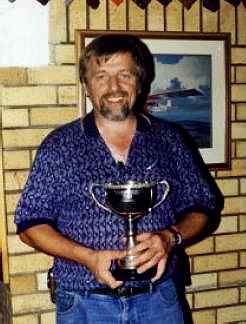
EP Precision Flying Winner 2000 - Hans Schwebel
Overall Winner – Hans Schwebel

Dave Perelson’s experience as a competitor showed with a very well thought out route with seven legs and an away start to complicate matters. The route distance was about 75NM. Miss the start and you can just as well go home. Most of us came back from the navex, confident that we found most of the secrets – not to be. Dave has put 3 secrets in villages and they were in positions where it was not only difficult to spot them due to the ‘busy’ environment, but also where you would not expect them. Another problem obviously was that it was difficult to fly your time accurately at these secrets. With a total of 10 timing points (6 secrets) the results reflected your real performance and took luck out of the equation. Isn’t this what Precision flying is all about – on track, on time, all the time.

By the time we were ready to do the landings, we had a wind of 20–25 Knots more or less down runway 25. Not finished with us, Dave decided that we should do 4 landings namely: 1) Power with flaps, 2) Glide with flaps, 3) Glide without flaps and 4) Obstacle landing. By the time the second group was airborne, low cloud came in and we had to do the glides from 800ft instead of the usual 1000ft.

In the navigation part of the competition, James Craven did the best with a total of 196 penalties followed by Hans Schwebel (313) , Jan Hanekom (387), Russell Phillips (695), Frikkie Lubbe (1181) and A van Vuuren (1445) in the Open Class.

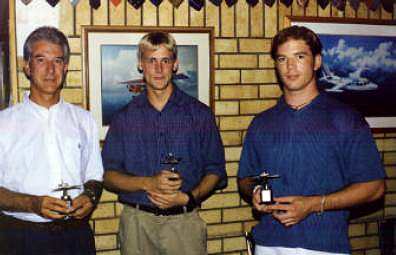
In the Sportsman Class we had R Hickman first (1139), followed by O Akerlund (1354), C Gerard (1602), A Taljaard (2084), D Renwick (2305), C du Plessis (2965) and J Saveur (3292).

EP Precision Flying Sportsmans Class - 2000 Gerard, Hickman & Akerland
First Three in the Sportsman Class


First Three in the Sportsman Class

The landing competition was won by Russell Phillips, closely followed by Jan Hanekom and Hans Schwebel with only 7 penalties between separating them. The penalties 33, 35 and 40 respectively for the four landings combined.

Overall Result – Open Class

  • 1 H Schwebel 353
  • 2 J Craven 383
  • 3 J Hanekom 422
  • 4 R Phillips 728
  • 5 F Lubbe 1492
  • 6 A van Vuuren 1827

Overall Result – Sportsman Class

  • 1 R Hickman 1469
  • 2 O Akerlund 1736
  • 3 C Gerard 1958
  • 4 A Taljaard 2501
  • 5 D Renwick 3195
  • 6 C du Plessis 3446
  • 7 J Sauveur 3784

I would like to thank all the competitors for their participation and hope to see everyone at the forthcoming events. A big thank you to Dave Perelson and is able team of marshals without whom we could not have the event. Last but not least, thanks to Algoa Flying Club and John and Mandy English of Progress for offering their facilities. It is indeed appreciated by everyone.


Tempe – Bloemfontein – 18 to 20 November 1999

By Adrian Pilling

Well before you know it most of the year has passed and we are into another National Precision Flying Championship, this time in Tempe Bloemfontein. As per usual the famous Free State friendliness was evident with the locals helping us out and really making us feel at home. Most of the countryside was looking pretty dry and brown clearly in need of rain….. a real test of navigation skills for the pilots.

The contestants arrived from all over the country including Hannes, Waltraud and Robin from Austria. The numbers were a little down this year, clearly a reflection of the economy, most pilots arriving during the official practice week. The format was a little different this year with the competition spread over three days, allowing for three navigation tests as well as for the four landings. This year was particularly significant as the national team would be announced as a result of this competition and previous regionals. This really heightened the competition amongst the contestants.

During the practice week a typical Free State storm suddenly brewed up and changed the sky from a perfect blue into a perfect violent mud storm. People were hanging onto the wing tips of planes in order to keep them on the ground. Complete mayhem for about 20 minutes and then as quickly as it came, it disappeared leaving a clean freshness in the air. This brief rainfall served to change the colours of the landscape just enough to make the observation of some of the photos more difficult. And so to the competition.

Thursday

The day dawned windy and dry. Willem Coetzee, the Competition Director, and his team (mostly parabats in training who had the day off due to the strong winds) set a course to the South West. This course was very cunning with turning points difficult to find if you drifted off course. The route took the pilots over a little koppie, surely nobody would be up there! Wrong – the parabats were up there with a secret timing gate and this took its toll of some of the pilots. After all the crews returned, a brief but welcome rest was followed by two of the four landings scheduled for the competition ( first the powered landing and then the glide). By the end of the evening the provisional results were; Navigation – 1st Nigel Hopkins, 2nd Hans Schwebel, 3rd Adrian Pilling, 4th Frank Eckard, 5th Jan Hanekom, 6th Barry de Groot. In the landing section – 1st Adrian Pilling, 2nd Nigel Hopkins.

Friday

This was the day that Willem threw the western route at us. It was a shorter route but one that had the crews working hard. The format was the same as the previous day with two landings (glide and barrier) following the navigation. By the end of the evening the results for the day were; Navigation – 1st Adrian Pilling, 2nd Nigel Hopkins, 3rd Frank Eckard, 4th Mary de Klerk, 5th James Craven, 6th Hans Schwebel. In the landings section – 1st Nigel Hopkins, 2nd Adrian Pilling.

Saturday

This was a tough day as the scores for the previous days had been so close, this day really counted more. This was the shortest of the routes and had a really tricky short leg that created some problems for the pilots when the wind changed. By the end of the day the placing were – 1st Nigel Hopkins, 2nd Mary de Klerk, 3rd Ron Stirk, 4th Adrian Pilling, 5th Frank Eckard, 6th Jan Hanekom. The scores today were really close.

After a brief period it was rush, rush, rush to a sumptuous reception planned by Willem and Annette. A really special meal was followed by the announcement of the final placing:-

Nigel Hopkins National Champion Precision Flying 1999

INDIVIDUAL RESULTS (Overall)

  • 1st – Nigel Hopkins 225 points
  • 2nd – Adrian Pilling 268 points
  • 3rd – Hans Schwebel 587 points
  • 4th – Ron Stirk 610 points
  • 5th – Frank Eckard 647 Points
  • 6th – Jan Hanekom 649 Points
  • 7th – Mary de Klerk 716 Points
  • 8th – Barry de Groot 917 Points
  • 9th – James Craven 1081 Points
  • 10th – Don Macintyre 1129 Points
  • 11th – Mauritz du Plessis 1460 Points
  • 12th – Dick Churley 1490 Points
  • 13th – Walter Walle 1976 Points
  • 14th – F. Lubbe 3477 Points
  • 15th – C.Bodesteyn 3656 Points
  • 16th – J.Kleynhans 4171 Points

Landings:

  • 1st – Nigel Hopkins
  • 2nd – Adrian Pilling
  • 3rd – Mary de Klerk
  • 4th – Ron Stirk
  • 5th – Mauritz du Plessis

Trophies:

  • Observation Trophy – Nigel Hopkins
  • Timing Trophy – Adrian Pilling
  • Best Private Pilot – Hans Schwebel
  • Best Club – Brits Flying Club
  • Best Province – North West Province

Provincial Colours were awarded for the first time to Mauritz du Plessis. Well done

Later in the evening the National Team was announced. This team will represent the country at the 14th World Precision Flying Championships in Sweden in 2000. The team is:-

  • Nigel Hopkins
  • Adrian Pilling (Captain)
  • Hans Schwebel
  • Ron Stirk
  • Barry de Groot
  • Jan Hanekom (1st Reserve)
  • Frank Eckard (2nd Reserve)
  • Mary de Klerk (3rd Reserve)
  • Deon van den Berg (Manager)

We wish the team all the best for the coming World Championships. I know we will do well. A special mention must go to Willem Coetzee – competition director, André Fourie – chief judge, Ros – computer, Annette – Social, Renier Moolman, Dave Perelson, Tempe Flying Club – facilities, the marshalls and everybody on the Tempe airfield.

A special thank you to our sponsor, IMPERIAL BANK.


Hamilton Airport, New Zealand – 20 to 27 February 1999

Extracted from an article by Phillip Treweek

The holding of the World Precision Flying Championships in New Zealand was quite a coup for the organisers. This was only the third time the competitions have been held in the southern hemisphere.

The competition was based in Hamilton. This is the traditional venue for the New Zealand national competition. The central location allows access to a variety of terrain for the navigation work, and Hamilton International Airport has a suitable amount of grass for the landing competitions. From the point of view of a large international competition, Hamilton city, has the accommodation and resources to support a large competition.

Opening Ceremony 1999 World Precision Championships - Bill Ottey
FAI representative Bill Ottley is escorted to the dais during the Powhiri or welcome

For the 1999 championships, 81 competitors from 23 countries attended. In addition there were supporters, judges, jury members, and helpers numbering in the hundreds. Even 24 personnel from the New Zealand Army attended, to assist with communications. Most gathered in the days leading up to the official opening on February 20th. Some competitors arrived early to practice in the local conditions.

The official opening started with a march on. Each team was led by a ‘Marching Girl’ bearing a sign identifying the team. Precision marching of this kind is a very New Zealand sport, and is a women only competition, very different to the military style of marching. The teams gathered in the car park, and then marched out to the ramp in front of the Waikato Aero Club (which served as the base for the competition).

The next stage was the Powhiri. That’s the Maori term for a ‘welcome’. Although mainly friendly these days, its origins are in the time when visitors might not have come with amicable intent. The Powhiri starts with a Karanga or call, inviting the Manuhiri or visitors to come forward. The next step is the Wero, or challenge. Two Toa (warriors) step forward and lay a token on the ground in front of the approaching visitors. If the token is picked up, this indicates the manuhiri are friendly – if it is not, then the vistors intentions are seen to be hostile.

Bill Ottley, as the FAI representative was the most senior of the visitors and accepted the Wero. As well as FAI representative Bill Ottley, the speakers included representatives from the organisors, local government, and the New Zealand Governor General, Sir Michael Hardie Boyes.

Opening Function 1999 World Precision Championships - John Fisher, Malcolm Evans and David Abraham
British team members John Fisher and Malcolm Evans talking to David Abraham, the sole Irish representative during the social hour of the opening ceremony.

The competitions consisted of several navigation tasks (and a practice day) and two landing days. The weather had some interesting effects. It was such a dry summer that the aerial photographs of some of the navigation targets had to be redone. The look of the targets had changed changed considerably as they dried out. The landing competitions also had to be moved as they disintegrated, and watering was required. Ironically, one outing late in the week (to Wharepapa South) was cancelled due to rain.

A good crowd of spectators gathered to watch the various attempts during the landing competition. It was interesting to note the different styles utilised by the different competitors. Some made a curving approach, some made a drop from on high, some came in low and keep the power on. The level of success varied too. Most competitors were on the grid, but one or two were short, and many went long.

Landings - 1999 World Precision Championships
Spectators on the crowd line. A good crowd turned out for the most watchable part of the competition.

The landing competition was in three sections. A standard landing, a flapless landing, and a barrier competition. The first two are fairly self explanatory. The third involved a 3m barrier being placed at the -50m mark. In practice this was a couple of poles with a string of flags which competitors flew over before making their landing. The barrier was dropped on several occassions when competitors got too low.

The most amazing part was being so close to the active aircraft. The grid was only 15 or 20m wide, and was lined with officials. A watcher sat on set divisions of the grid. Closer in, more observers made a measurement on each of the competitors who were closer to the mark. Several cameras recorded each attempt. And of course the judges sat and watched all the activity. A small portable control tower provided by the Airways Corporation kept track of movements, and was positioned next to the grid. It was really something to see the aircraft flying in and out amongst all these people. The aircraft came thick and fast. The tower recorded 81 competitors passed through the grid in 68 minutes during one section of the competition. Precision flying indeed. For a photographer it was quite stunning to have all these opportunities parade past my lens. It was different to see so many aircraft in the circuit.

Landings - 1999 World Precision Championships
The Airways Corporation provided a small portable tower. The officials are clearly watching the next approach. The grid markings can be seen in the foreground. The last competitors distance is shown on the display

The eventual outcome of the Championships saw Poland win (for the eighth time), with New Zealand in second place, and the Czech Republic third. A prize ceremony was held at Vilograd’s, a local restaurant set in a vineyard at Ngahinapouri.

Individual winners were Janusz Darocha of Poland followed by Daroish Krady of New Zealand and Jiri Jakes of the Czech Republic. In the Women’s competition Nathalie Strube of France was the winner, followed by Dee Bond-Wakelin of New Zealand and Ines Meier of Switzerland. Amongst the low houred (under 500) pilots, the competition winner was Greg Ward (New Zealand) followed by Hakon Fosso (Norway) and Johan Nyler (Sweden). The navigation competition went to Hungary (Laszio Bodis) with Poland in second (Michalski Ryszard) and third place (Janusz Darocha). The landing competition was taken out by Croatia (Zelimir Trifunovic) followed by New Zealand (Daroish Krady) and Slovenia (Robert Verbaci). The award for sportsmanship went to Sofia Svellossanova of Russia.

Full article and more picture on the website of Phillip Traweek – Kiwi Aircraft Images