
Articles Precision (Page 15)

Hamilton Airport, New Zealand – 20 to 27 February 1999

Extracted from an article by Phillip Treweek

The holding of the World Precision Flying Championships in New Zealand was quite a coup for the organisers. This was only the third time the competitions have been held in the southern hemisphere.

The competition was based in Hamilton. This is the traditional venue for the New Zealand national competition. The central location allows access to a variety of terrain for the navigation work, and Hamilton International Airport has a suitable amount of grass for the landing competitions. From the point of view of a large international competition, Hamilton city, has the accommodation and resources to support a large competition.

Opening Ceremony 1999 World Precision Championships - Bill Ottey
FAI representative Bill Ottley is escorted to the dais during the Powhiri or welcome

For the 1999 championships, 81 competitors from 23 countries attended. In addition there were supporters, judges, jury members, and helpers numbering in the hundreds. Even 24 personnel from the New Zealand Army attended, to assist with communications. Most gathered in the days leading up to the official opening on February 20th. Some competitors arrived early to practice in the local conditions.

The official opening started with a march on. Each team was led by a ‘Marching Girl’ bearing a sign identifying the team. Precision marching of this kind is a very New Zealand sport, and is a women only competition, very different to the military style of marching. The teams gathered in the car park, and then marched out to the ramp in front of the Waikato Aero Club (which served as the base for the competition).

The next stage was the Powhiri. That’s the Maori term for a ‘welcome’. Although mainly friendly these days, its origins are in the time when visitors might not have come with amicable intent. The Powhiri starts with a Karanga or call, inviting the Manuhiri or visitors to come forward. The next step is the Wero, or challenge. Two Toa (warriors) step forward and lay a token on the ground in front of the approaching visitors. If the token is picked up, this indicates the manuhiri are friendly – if it is not, then the vistors intentions are seen to be hostile.

Bill Ottley, as the FAI representative was the most senior of the visitors and accepted the Wero. As well as FAI representative Bill Ottley, the speakers included representatives from the organisors, local government, and the New Zealand Governor General, Sir Michael Hardie Boyes.
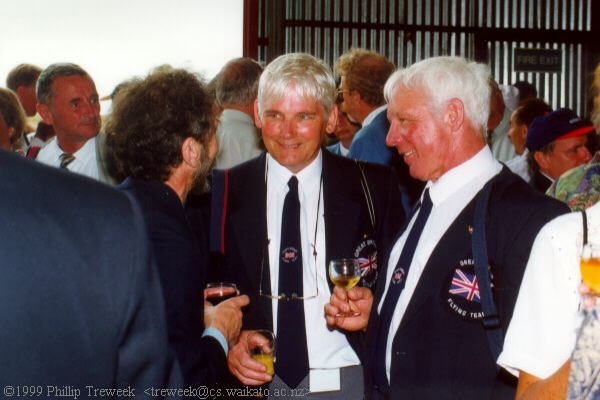
Opening Function 1999 World Precision Championships - John Fisher, Malcolm Evans and David Abraham
British team members John Fisher and Malcolm Evans talking to David Abraham, the sole Irish representative during the social hour of the opening ceremony.

The competitions consisted of several navigation tasks (and a practice day) and two landing days. The weather had some interesting effects. It was such a dry summer that the aerial photographs of some of the navigation targets had to be redone. The look of the targets had changed changed considerably as they dried out. The landing competitions also had to be moved as they disintegrated, and watering was required. Ironically, one outing late in the week (to Wharepapa South) was cancelled due to rain.

A good crowd of spectators gathered to watch the various attempts during the landing competition. It was interesting to note the different styles utilised by the different competitors. Some made a curving approach, some made a drop from on high, some came in low and keep the power on. The level of success varied too. Most competitors were on the grid, but one or two were short, and many went long.

Landings - 1999 World Precision Championships
Spectators on the crowd line. A good crowd turned out for the most watchable part of the competition.

The landing competition was in three sections. A standard landing, a flapless landing, and a barrier competition. The first two are fairly self explanatory. The third involved a 3m barrier being placed at the -50m mark. In practice this was a couple of poles with a string of flags which competitors flew over before making their landing. The barrier was dropped on several occassions when competitors got too low.

The most amazing part was being so close to the active aircraft. The grid was only 15 or 20m wide, and was lined with officials. A watcher sat on set divisions of the grid. Closer in, more observers made a measurement on each of the competitors who were closer to the mark. Several cameras recorded each attempt. And of course the judges sat and watched all the activity. A small portable control tower provided by the Airways Corporation kept track of movements, and was positioned next to the grid. It was really something to see the aircraft flying in and out amongst all these people. The aircraft came thick and fast. The tower recorded 81 competitors passed through the grid in 68 minutes during one section of the competition. Precision flying indeed. For a photographer it was quite stunning to have all these opportunities parade past my lens. It was different to see so many aircraft in the circuit.
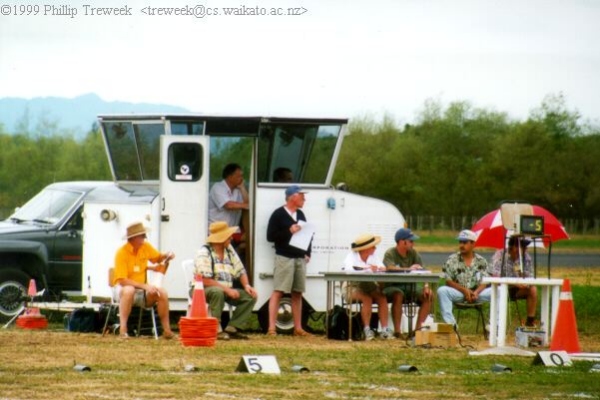
Landings - 1999 World Precision Championships
The Airways Corporation provided a small portable tower. The officials are clearly watching the next approach. The grid markings can be seen in the foreground. The last competitors distance is shown on the display

The eventual outcome of the Championships saw Poland win (for the eighth time), with New Zealand in second place, and the Czech Republic third. A prize ceremony was held at Vilograd’s, a local restaurant set in a vineyard at Ngahinapouri.

Individual winners were Janusz Darocha of Poland followed by Daroish Krady of New Zealand and Jiri Jakes of the Czech Republic. In the Women’s competition Nathalie Strube of France was the winner, followed by Dee Bond-Wakelin of New Zealand and Ines Meier of Switzerland. Amongst the low houred (under 500) pilots, the competition winner was Greg Ward (New Zealand) followed by Hakon Fosso (Norway) and Johan Nyler (Sweden). The navigation competition went to Hungary (Laszio Bodis) with Poland in second (Michalski Ryszard) and third place (Janusz Darocha). The landing competition was taken out by Croatia (Zelimir Trifunovic) followed by New Zealand (Daroish Krady) and Slovenia (Robert Verbaci). The award for sportsmanship went to Sofia Svellossanova of Russia.

Full article and more picture on the website of Phillip Traweek – Kiwi Aircraft Images


Held in Brits – 22- 24 September 1995

By Mary de Klerk and Adrian Pilling

By Thursday 21 September, the Brits skies were full of aircraft practicing Navex’s and landings. Everyone was hyped up and ready to go. That night a dinner was arranged at a restaurant in Brits called Saddles. About 40 people took over the restaurant for the evening.

Friday 22nd September – the official practice day. Adrian Pilling had arranged the route with photos. All were given official flight planning and takeoff times, and these were adhered to with military precision. Although there were no marshalls or ground markers, there were no undue hitches and everyone seemed happy with their individual performances.

That afternoon the SAPFA AGM was held at the airfield and chaired very precisely by Geoff Henschel. At 19h30, the mayor of Brits Mr. Kobus de Jager, hosted the official opening ceremony and welcome party at the Mayoral Chambers in Brits. This was attended by most of the councilors and their wives. The Brits Flying Club is most fortunate in having the support of the Town Council in providing assistance in whatever way they can.

Saturday 23rd September 1995 – the big day. The ball started rolling at 0800 with the first man in the flight planning room. Thereafter everyone entered at three minute intervals, and besides one minor glitch in the computer system, everything ran on oiled wheels. With professionals Uli Gerth, Andre Fourie and Ros Gibson at the helm, precious little could go wrong. Hats off to Johan Schraader for setting routes which were very fair and without hidden complications. The biggest problem was eleven year old maps and precious little on the ground fitted the paper. Thank goodness nobody moved the mountains and rivers because the roads and mines have developed so dramatically in some areas. We could have been flying on a Grahamstown map. It’s at times like this that a little local knowledge goes a long way. The first day’s navigation exercise was a real challenge, as the route flown took one over the beautiful Hartebeespoort Dam and along the ridge of the Magaliesburg mountains. It was a constant battle to stop looking at the natural beauty of the surroundings and concentrate on the task at hand, and you had to concentrate as there were 8 turning point markers to be found along with 4 secret checkpoints, 8 photographs and numerous ground markers.

The marshalls were all well briefed, and the numerous secrets and ground markers were accurately displayed. Only one timed secret which had no identifiable marker, tended to catch a lot of unsuspecting “speedsters”. At the end of the first day a braai was arranged at the club house, and a lot of weary pilots tended to relax and let their hair down, and one or two cases, their pants … (no names – no pack drill!!!)

The second official rally day dawned and all arrived on time. Again a hitch-free and relatively uneventful day, except for Basil Killian, a “new boy from Durbs” who somehow tugged too hard on his Carb heat and had to fly the entire rally with the dead cable handing from his hands – and short of a few revs. He knew he was late when his team mate, Richard O’Neil passed him over the dam, but decided to tag Richard and limp home.

All the landings were video’d so any disputes or protests could be very quickly ironed out. Nols van Emmenis, the manager of the club, bent over backwards to accommodate all the pilots and their families, and even when the newly installed fuel pumps let him down, he failed to get flustered. His wife, and her entourage of ladies, did a sterling job in the kitchen, feeding and watering the crews from early morning till late in the evening

At the end of the second and final day a prize-giving banquet was held in the bushveld lapa at Dikhololo. This function was attended by 150 guests, comprising of pilots, marshalls, organisers, supporters, families and friends. Andre Fourie was master of ceremonies and prizes were presented by the deputy Mayor of Brits, Mr. Matlala and the deputy Mayoress Miss Buys.

Prizes were awarded in the following categories:

  • First Place Overall – Adrian Pilling
  • Second Place Overall – Hans Schwebel
  • Third Place Overall – James Craven
  • Fourth Place Overall – Geoff Henschell
  • Fifth Place Overall – Johan Dorfling
  • Best Private Pilot – Hans Schwebel
  • Best Navigator (Timing) – Geoff Henschel
  • Best Navigator (Observation) – Daroish Kraidy
  • First Place Landings – James Craven
  • Best Club – Brits Flying Club
  • Best Province – North Gauteng

The big moment that everyone was waiting for had arrived, the selection of the Springbok team to represent South Africa at the 1996 World Precision Flying Championships in Fort Worth Texas USA are: Adrian Pilling, James Craven, Geoff Henschel (Captain), Johan Dorfling, Hans Schwebel, Deon van Eeden (Manager), Johan Swart (International Judge).

A reserve team was also chosen: Nellis Nel, Barry de Groot and Daroish Kraidy

This story would not be complete without a huge thanks going to MLS Bank that made it all possible. Your continuing support of power flying is greatly appreciated

Held at Karlovay Vary, Czech Republic – 17 July to 31 July 1994

By Adrian Pilling

The team assembled at Jan Smuts from all over the country on Saturday 16th July. Here a cocktail party was held for family and friends before departing. The flight was on SAA to Frankfurt. We arrived the next morning and were greeted by a temperature climbing well into the 30’s.

We split into two groups. Group 1 comprising Hans, Johan, Nellis and James, Group 2 comprising Adrian, Barry, Deon and Daroish. Group 1 left by car for the airfield where their planes were based, whilst group 2, left by train for the Czech border.

After 5 hours the train arrived at the town of Marktredwitz, where a very nice couple (prearranged) picked us up and took us by car to the Czech town of Karlovy Vary (formerly Karlsbad). We checked into this magnificent hotel (Hotel Pupp with casino) built in 1701. As it was late we immediately set about exploring the town in order to find a place to eat.

Monday morning we managed to get to the airfield only to find that our plane which was supposed to be there, was in fact still in Germany and could not fly back due to really bad weather. This weather pattern persisted for three days and indeed neither our team mates or any other team could get through. What a disaster.

Tuesday was more of the same so Adrian decided to rent a plane from one of the Norwegian pilots already on the field, and flew a nice practice nav. This he prepared for the pilots as a training route for Wednesday. Still no planes and no team mates. We decided to concentrate on map work (very necessary as the scale is 1:200 000 and the colours very pale) and prayer wheel practice. The opportunity was taken to see parts of this magnificent old town with it’s wonderful hot spas.

Wednesday was a day when our plane returned and we decided to start the practising in earnest. Some time was spent on landings and navigation. Later the others from Germany had had enough of this waiting and decided to drive through, joining us for a late lunch.

Thursday was a really intensive training day. The rest of the team drove back to Germany and joined us by air a little later. At last we were all together. The rest of the week was spent in intensive training. The official landing slots becoming more and more precious, as the time allocated each day was reduced due to other teams arriving.

1994 South African Precision Flying Team
Rear L to R: James Craven, Daroish Kraidy, Hans Schwebel, Nellis Nel and Barry de Groot. Front L to R: Adrian Pilling, Deon van Eeden and Johan Swart.

One amusing incident was when the competition director proudly marched in with our flag to show us just how on the ball they were … you guessed it, the wrong flag. We had to lend them one of ours, which was much smaller than their large, non-standard ones.

Monday was used as an official landing practise test day. This was great as it gave all the judges a work out as well as giving the pilots a dry run for the big event. Deon was in charge of the landing computer and was able to learn a great deal about this Swiss system. Valuable knowledge for this country. The official opening was held in the grand hall at the hotel. It was a very glamorous, if restrained affair. Guess what! They had made a flag for us, but had left out the yellow stripe (still 5 out of 6 colours is not bad).

Tuesday was an official practise navigation test day. This was great as it put pilots under the sort of pressure they would get on the big day. We all learned a lot, especially about how the competition organisers think. We all got to bed early as the next day was the first navigation test.

Wednesday dawned bright but not so clear. At the compulsory briefing it was decided that due to the potential for thunderstorms the landings would be held that day. What a surprise. So we all trundled out to the flight line. Here the first landing was run, a runway change was ordered due to the wind swinging around. Later the next two landings were run on a touch and go basis. This was actually a little unfair as the first 5 groups had terribly gusty weather. The management decided to call a halt for a while. Later the wind calmed significantly and the rest of the field got under way. There were many protests about this but the earlier landing results stood. The final landing was done in such a way that you took off on the grass runway and landed on the tar. This is a great system as it is very quick. At the end of the day we had a new World Landing Champion. He is Johan Gutman from Austria. His total penalties … just 4. Our team placings were Nellis (31), Daroish (34), James (36), Johan (45), Hans (47) and Barry (5 1). Johan’s was one of those pilots who was affected by the strong winds.

Thursday dawned bright and a little breezy. The first navigation test was flown this day. The organisers were quite sneaky as they gave everybody a zero wind velocity for flight planning. Our pilots returned, almost all uniformly disheartened. It had been difficult and mistakes had been made. Still the results were not known until the next morning after all the protests had been made. These protests went on until well after midnight. One of the Poles scored zero penalties!!!

Friday was the day for the second navigation test. This was a great day and the route was loved by everybody. The Czech team decided to host a party in the hangar. This was great as it allowed everybody to blow off steam. The results were announced at 9 pm in the hotel. Our boys had done well today but the main damage had been done the previous day. Daroish and James scoring particularly well today.

Saturday was a free day and an excursion to the aircraft museum by bus was arranged. The trip was almost three hours there. We were given lunch in Prague and then off to the aviation museum. This is well worth a visit. We had a coke under a SAM 2 missile, stood next to a Vl flying bomb, looked into a Soviet space capsule and had our pictures taken next to dozens of MIG and Sukhoi jet fighters. What a great experience. The bus ride back was hot and rushed as the official closing ceremony started at 8pm.

The ceremony was fun and the results predictable. Poland 1st, 2nd, 3rd, Sweden 4th, Czech 5th. Overall team positions were Poland lst, Czech Republic 2nd, and Sweden 3rd.

Our placings were: Daroish 30, Barry 51, Nellis 58, Hans 55, James 54, Johan 57. Officially Hans was an independent and as such his scores are not reflected in official results. Our team placing was 12th out of a total of 19 countries and 75 pilots.

We did a roaring trade in T-shirts and if any team should have got a prize for trying the hardest, for being the most fun team and for being the most colourful team, then it should have been US. Well done to the team, who did extremely well, considering their experience level. We now have a good basis upon which too choose for the 1996 WPFC in the USA. I am proud of our team and of the friendships made. We flew our new flag well…